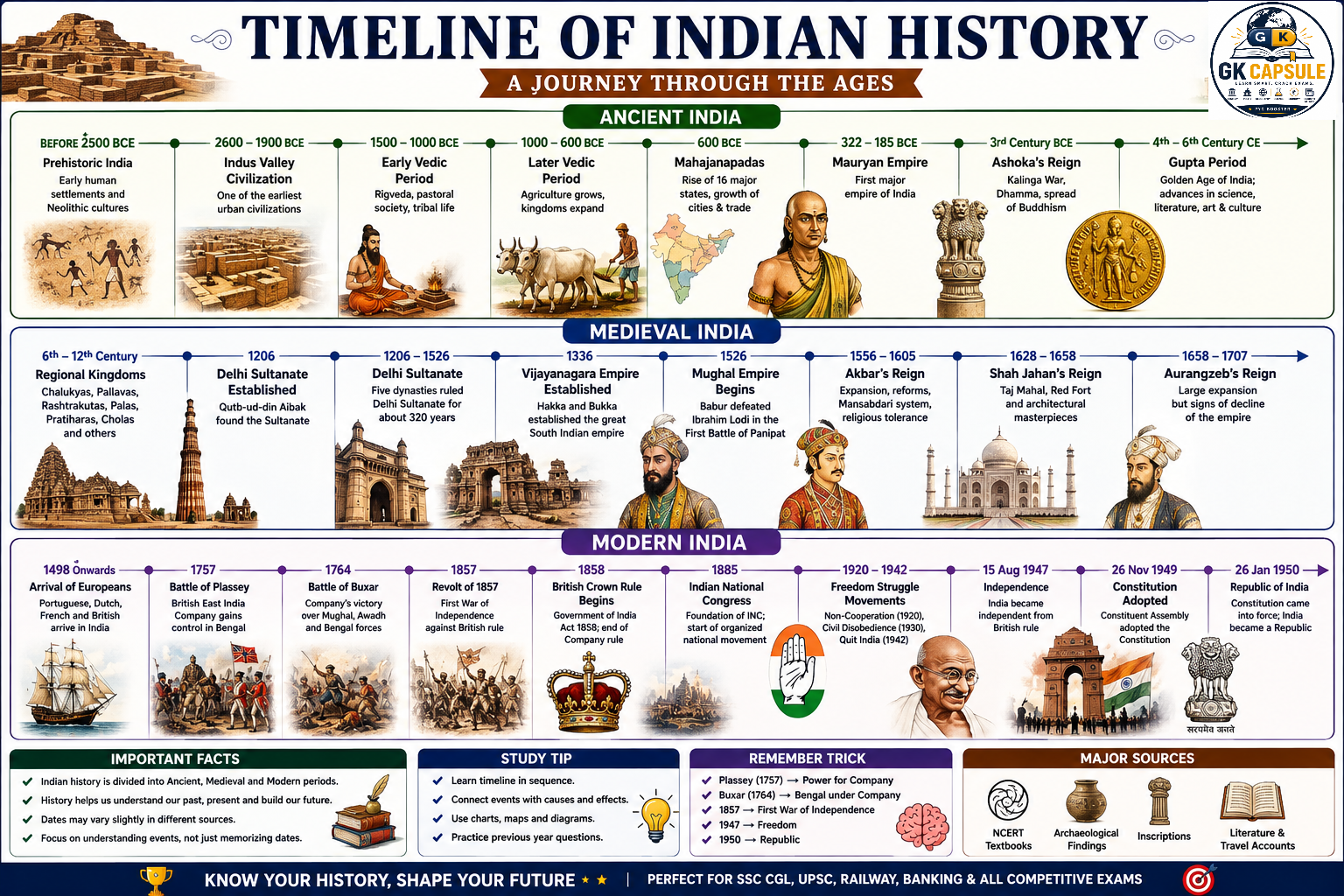
Timeline of Indian History: Ancient, Medieval & Modern India
From the Indus Valley Civilization to the Republic of India — every dynasty, battle, Act and movement in chronological order, built for SSC CGL, UPSC, Railway and Banking exam prep.
SSC CGLSSC CHSLUPSCRailway NTPCBankingCDS & CAPF
Quick Answer
Indian history is broadly studied through Ancient, Medieval, and Modern periods. Major milestones include the Indus Valley Civilization, Vedic period, rise of the Mahajanapadas, Mauryan Empire, Gupta period, Delhi Sultanate, Vijayanagara Empire, Mughal Empire, British rule, the Revolt of 1857, the Indian national movement, Independence in 1947, and the adoption of the Constitution in 1950. NCERT also emphasizes that historical periodisation is a framework for studying change over time rather than simply a list of dates.
Complete Timeline of Indian History — Major Dynasties, Emperors, Battles & Freedom Movement Chronology📥 Download High-Res Infographic
The Timeline of Indian History covers thousands of years of political, social, economic, religious, and cultural developments — from prehistoric settlements and the Indus Valley Civilization to the rise of the Mauryas, Guptas, Delhi Sultanate, Mughals, British rule, the Indian freedom movement, and the establishment of the Republic of India.
For SSC CGL, SSC CHSL, UPSC, Railway, Banking, CDS, CAPF, NDA, and State PSC aspirants, studying Indian history chronologically makes it easier to connect rulers, dynasties, battles, movements, Acts, and important events.
Indian History Timeline at a Glance
Period / Event
Approximate Date
Key Importance
Prehistoric India
Before c. 2500 BCE
Early human settlements and cultures
Indus Valley Civilization
c. 2600–1900 BCE
Early urban civilization
Early Vedic Period
c. 1500–1000 BCE
Vedic society and culture
Later Vedic Period
c. 1000–600 BCE
Expansion of kingdoms and agriculture
Mahajanapadas
c. 600 BCE
Rise of major states
Mauryan Empire
c. 322–185 BCE
First major pan-Indian empire
Ashoka's reign
3rd century BCE
Buddhism and Dhamma
Gupta Period
c. 4th–6th century CE
Major developments in science, literature and art
Delhi Sultanate
1206–1526
Establishment of successive Sultanate dynasties
Vijayanagara Empire
1336 onward
Major South Indian imperial power
Mughal Empire
1526 onward
Major early-modern empire
Battle of Plassey
1757
Major turning point in Company expansion
Revolt of 1857
1857
Major uprising against Company rule
Crown Rule
1858–1947
Direct British rule
Indian National Congress
1885
Organized national political movement
Non-Cooperation Movement
1920–22
Mass anti-colonial movement
Civil Disobedience Movement
1930–34
Major phase of freedom struggle
Quit India Movement
1942
Final major mass movement
Independence
15 August 1947
End of British rule
Constitution adopted
26 November 1949
Constitution adopted by Constituent Assembly
Republic of India
26 January 1950
Constitution came into force
Ancient Indian History Timeline Ancient
01
Prehistoric India
The history of the Indian subcontinent begins long before written records.
Important prehistoric stages include:
Paleolithic Age
Mesolithic Age
Neolithic Age
Chalcolithic cultures
Archaeological evidence from tools, settlements, pottery, burials, and other remains helps historians understand these societies.
02
Indus Valley Civilization c. 2600–1900 BCE
The Indus Valley Civilization, also called the Harappan Civilization, was one of the earliest urban civilizations of South Asia. Its mature phase is generally dated to around 2600–1900 BCE.
Important Sites
Harappa
Mohenjo-daro
Dholavira
Lothal
Kalibangan
Rakhigarhi
The civilization is known for planned cities, drainage systems, standardized weights and measures, craft production, long-distance trade, and distinctive seals. For exam preparation, remember the major archaeological sites and their characteristic discoveries.
Ancient History Key Visual — Prehistoric India to Indus Valley & Gupta Era
03
Vedic Period
The Vedic period is generally divided into two phases.
Early Vedic Period — Approximately 1500–1000 BCE. The Rigveda is the earliest Vedic text and provides important evidence about early Vedic society.
Later Vedic Period — Approximately 1000–600 BCE. During this period, agriculture expanded, settlements became more extensive, and larger political units developed.
04
Mahajanapadas c. 600 BCE
By around the 6th century BCE, several major states had emerged in northern India, traditionally known as the 16 Mahajanapadas.
Magadha
Kosala
Vatsa
Avanti
Vajji
Magadha eventually became the dominant political power in northern India.
05
Rise of Buddhism and Jainism
The 6th century BCE witnessed important religious and philosophical developments. Gautama Buddha founded Buddhism, while Mahavira was the 24th Tirthankara of the Jain tradition and a major contemporary of the Buddha.
Questions about Buddhism, Jainism, their founders, teachings, councils, and important sites are common in competitive examinations.
06
Mauryan Empire c. 322–185 BCE
The Mauryan Empire was established by Chandragupta Maurya around the late 4th century BCE. Important rulers include Chandragupta Maurya, Bindusara, and Ashoka. The Mauryan state became one of the largest political formations in ancient Indian history.
07
Ashoka and the Mauryan Empire 3rd century BCE
Ashoka, one of the best-known Mauryan rulers, ruled in the 3rd century BCE. After the Kalinga War, Ashoka promoted Dhamma and supported the spread of Buddhism.
Important Sources
Rock Edicts
Pillar Edicts
Inscriptions
The Lion Capital of Sarnath, derived from an Ashokan pillar capital, is now India's national emblem.
08
Post-Mauryan Period
After the decline of the Mauryan Empire, several regional and transregional powers emerged, including the Shungas, Indo-Greeks, Shakas, Kushanas, and Satavahanas.
The Kushana Empire, particularly under Kanishka, played an important role in trade and the development of Buddhist traditions.
09
Gupta Period c. 4th–6th century CE
The Gupta Empire emerged in northern India around the 4th century CE. Important rulers include Chandragupta I, Samudragupta, Chandragupta II, Kumaragupta, and Skandagupta.
The Gupta period is associated with important developments in Sanskrit literature, mathematics, astronomy, sculpture, architecture, and political and economic history. Samudragupta's achievements are recorded in the Prayaga Prashasti, composed by Harisena.
Medieval Indian History Timeline Medieval
10
Early Medieval Regional Kingdoms
After the decline of major ancient empires, numerous regional powers became prominent, including the Chalukyas, Pallavas, Rashtrakutas, Palas, Pratiharas, and Cholas.
The Chola Empire became a major power in southern India, particularly under rulers such as Rajaraja I and Rajendra I.
11
Delhi Sultanate 1206–1526
The Delhi Sultanate was established in 1206 and continued until the Mughal conquest in 1526. NCERT's historical timeline identifies the establishment of the Delhi Sultanate in 1206.
Major Dynasties
Slave / Mamluk Dynasty
Khalji Dynasty
Tughlaq Dynasty
Sayyid Dynasty
Lodi Dynasty
Important rulers include Qutb-ud-din Aibak, Iltutmish, Razia, Alauddin Khalji, Muhammad bin Tughlaq, Firoz Shah Tughlaq, and Sikandar Lodi.
The Vijayanagara Empire was established in the 14th century, traditionally dated to 1336. Its capital, Vijayanagara, was located at present-day Hampi in Karnataka. The empire became an important political, economic, and cultural centre in southern India.
13
Mughal Empire 1526 onward
The Mughal Empire began with Babur's victory over Ibrahim Lodi at the First Battle of Panipat in 1526. Important Mughal rulers include Babur, Humayun, Akbar, Jahangir, Shah Jahan, and Aurangzeb.
NCERT's Mughal timeline records Babur's victory at Panipat in 1526, Akbar's reign from 1556–1605, Shah Jahan's reign from 1628–1658, and Aurangzeb's reign from 1658–1707.
14
Akbar's Reign 1556–1605
Akbar became emperor in 1556. Important areas associated with his reign include expansion of the Mughal Empire, administrative reforms, the Mansabdari system, revenue administration, relations with Rajput states, and cultural developments.
Akbar's reign is one of the most frequently tested topics in Medieval Indian History.
15
Shah Jahan and Aurangzeb
Shah Jahan's reign is particularly associated with Mughal architecture, including the Taj Mahal.
Aurangzeb ruled from 1658 to 1707 and presided over a period of major territorial expansion as well as growing political challenges.
Modern Indian History Timeline Modern
16
Arrival of European Trading Companies
European powers established trading networks and settlements in India, including the Portuguese, Dutch, English, and French. The English East India Company gradually transformed from a trading organization into a major political power.
17
Battle of Plassey 1757
The Battle of Plassey was fought in 1757. The victory of the East India Company in Bengal became a major turning point in the expansion of Company political influence.
18
Battle of Buxar 1764
The Battle of Buxar was another major event in the consolidation of East India Company power. The subsequent political developments strengthened Company control over Bengal and its revenue administration.
19
Revolt of 1857 1857
The Revolt of 1857 was a major uprising against East India Company rule.
Important Centres
Delhi, Kanpur, Lucknow, Jhansi, Bareilly
Important Personalities
Bahadur Shah II, Rani Lakshmibai, Nana Sahib, Tantia Tope, Begum Hazrat Mahal
The revolt resulted in the end of East India Company rule.
Modern History Key Visual — East India Company, Revolt of 1857 & Crown Rule
20
Beginning of British Crown Rule 1858
The Government of India Act 1858 transferred the administration of India from the East India Company to the British Crown. Lord Canning became the first Viceroy under Crown rule.
21
Formation of Indian National Congress 1885
The Indian National Congress was founded in 1885 and became one of the most important organizations in India's national movement.
Important leaders over different phases included Dadabhai Naoroji, Gopal Krishna Gokhale, Bal Gangadhar Tilak, Mahatma Gandhi, Jawaharlal Nehru, and Subhas Chandra Bose.
22
Partition of Bengal 1905
Lord Curzon announced the Partition of Bengal in 1905. The decision contributed to the growth of the Swadeshi Movement and intensified nationalist politics. The partition was annulled in 1911.
23
Home Rule Movement
The Home Rule Movement emerged during the First World War period, led by Bal Gangadhar Tilak and Annie Besant, demanding greater self-government for India.
24
Gandhi and the National Movement
Mahatma Gandhi became a central figure in India's freedom struggle.
Non-Cooperation Movement — 1920
A mass movement against colonial rule.
Civil Disobedience Movement — 1930
The movement began with the Dandi March and the Salt Satyagraha.
Quit India Movement — 1942
Launched during the Second World War, the movement called for an end to British rule.
25
Government of India Act 1935
The Government of India Act 1935 was a major constitutional development during British rule. It provided for provincial autonomy, a proposed federation, and expanded legislative arrangements, and significantly influenced subsequent constitutional developments.
26
Independence and Partition 15 Aug 1947
India became independent on 15 August 1947. The end of British rule was accompanied by the Partition of British India, leading to the creation of India and Pakistan.
Independence & Constitutional Development — 1947 to 1950
27
Constitution and Republic of India 1949–1950
The Constituent Assembly adopted the Constitution of India on 26 November 1949. The Constitution came into force on 26 January 1950, and India became a republic — marking the beginning of the constitutional history of the Republic of India.
Indian History Timeline: Important Dates for Exams
Date
Event
c. 2600–1900 BCE
Mature Harappan Civilization
c. 1500 BCE
Beginning of commonly used Vedic chronology
c. 600 BCE
Rise of Mahajanapadas
c. 322 BCE
Rise of Mauryan Empire
3rd century BCE
Reign of Ashoka
c. 4th century CE
Rise of Gupta Empire
1206
Delhi Sultanate established
1336
Traditional date for Vijayanagara Empire
1526
First Battle of Panipat; Mughal Empire established
1757
Battle of Plassey
1764
Battle of Buxar
1857
Revolt of 1857
1858
Beginning of Crown rule
1885
Indian National Congress founded
1905
Partition of Bengal
1911
Capital shifted from Calcutta to Delhi; Bengal partition annulled
1919
Government of India Act; Jallianwala Bagh massacre
1920
Non-Cooperation Movement
1930
Civil Disobedience Movement
1935
Government of India Act
1942
Quit India Movement
1947
Indian Independence
1949
Constitution adopted
1950
India became a republic
Ancient vs Medieval vs Modern Indian History
Ancient India
Early civilizations, Vedic culture, Mahajanapadas, Mauryas, Guptas
European expansion, Company rule, British Crown, national movement, Independence
Remember that these divisions are study frameworks, and historians debate the boundaries and characteristics of historical periods. NCERT explicitly presents history as a discipline based on evidence and interpretation rather than simply a collection of dates.
How to Study the Timeline of Indian History
01
Learn History in Three Blocks
Start with Ancient → Medieval → Modern, then divide each block into dynasties and major events.
02
Connect Rulers With Events
Ashoka → Kalinga and Dhamma
Samudragupta → Prayaga Prashasti
Akbar → Administration and expansion
Dalhousie → Doctrine of Lapse
Curzon → Partition of Bengal
Gandhi → Mass movements
03
Practice Dates Selectively
Don't try to memorize every date. Focus on dates associated with major battles, important Acts, dynasties, national movements, Independence, and constitutional developments.
04
Use Maps and Timelines
A visual timeline can help connect geographical expansion with political developments.
The timeline of Indian history covers major developments from prehistoric cultures and the Indus Valley Civilization through the ancient, medieval, and modern periods to Independence in 1947 and the establishment of the Republic in 1950.
What are the three main periods of Indian history?
Indian history is commonly divided into Ancient, Medieval, and Modern periods for study purposes.
Which is the earliest major urban civilization in India?
The Indus Valley or Harappan Civilization is one of the earliest major urban civilizations of the Indian subcontinent.
When was the Mauryan Empire established?
The Mauryan Empire rose in the late 4th century BCE under Chandragupta Maurya, conventionally dated to around 322 BCE.
When was the Delhi Sultanate established?
The Delhi Sultanate was established in 1206.
When did the Mughal Empire begin?
The Mughal Empire began in 1526, following Babur's victory over Ibrahim Lodi at the First Battle of Panipat.
When was the Indian National Congress founded?
The Indian National Congress was founded in 1885.
When did India become independent?
India became independent on 15 August 1947.
When did India become a republic?
India became a republic on 26 January 1950, when the Constitution came into force.
Practice What You've Just Learned
Take a free Indian History quiz on GK Capsule — chapterwise and mixed mode, no login needed.
The Timeline of Indian History is an effective way to understand the sequence of India's major civilizations, kingdoms, empires, colonial developments, and national movements. Instead of memorizing isolated facts, connect each ruler or dynasty with its major achievements, battles, administrative changes, and cultural developments.
For SSC CGL, UPSC, Railway, Banking, CDS, CAPF, and State PSC preparation, concentrate especially on major dates, dynasties, battles, Acts, social reforms, national movements, and constitutional milestones.
Use this timeline as a foundation, then strengthen your preparation with Modern History MCQs, Ancient History GK, Medieval History MCQs, previous-year questions, maps, and revision charts.