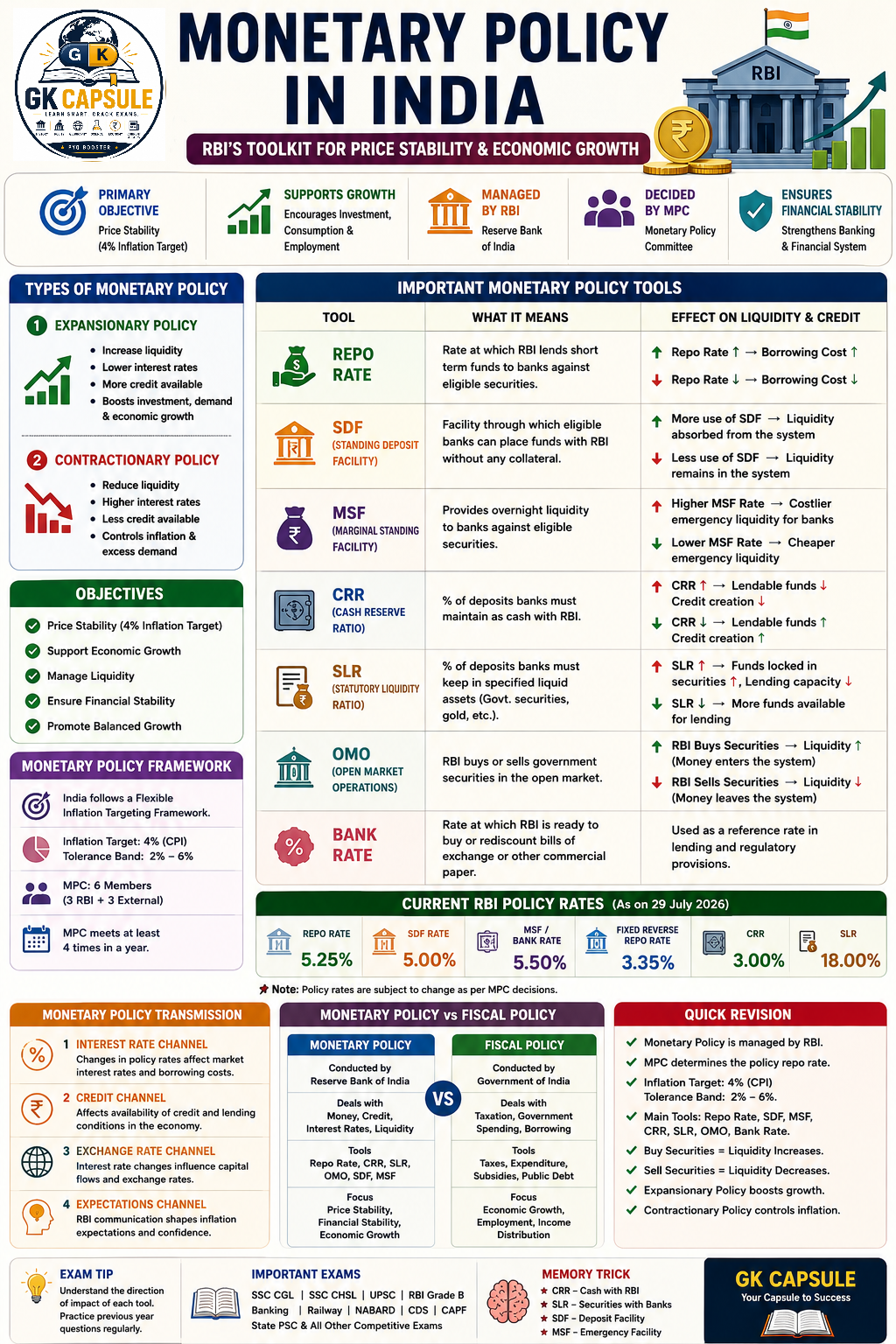
A Core Indian Economy Topic
Monetary policy connects the RBI, inflation, banking, and government finance — making it one of the most consistently tested Economy topics across SSC, Banking, and UPSC exams.
What Is Monetary Policy & Who Controls It?
Monetary policy refers to the actions a central bank takes to influence the availability and cost of money and credit in the economy. In India, the RBI conducts monetary policy, while the MPC determines the policy repo rate needed to hit the inflation target.
In simple words, monetary policy is the set of decisions the Reserve Bank of India takes about how much money should circulate in the economy and how expensive or cheap it should be to borrow that money. Every time the RBI changes the repo rate, adjusts CRR, or buys and sells government securities, it is exercising monetary policy. This is different from fiscal policy — taxation and government spending — which is handled by the Ministry of Finance, not the RBI. Because monetary policy sits at the intersection of banking, inflation, and government finance, it is one of the most frequently tested static-GK and current-affairs blends in SSC, Banking, Railway, and UPSC exams.
RBI Monetary Policy — how the framework evolved: Before 2016, the RBI Governor had significant discretion in setting the policy repo rate, guided by an internal technical advisory committee whose recommendations were not binding. After amendments to the RBI Act in 2016, India formally adopted a Flexible Inflation Targeting (FIT) framework, and the decision-making power shifted to the six-member Monetary Policy Committee. The Governor chairs the MPC and holds a casting vote in case of a tie, but each member — RBI or external — has one vote, making the repo rate decision a collective, statutory responsibility rather than a single individual's call. The MPC's resolution, along with the minutes of the meeting, is published to keep the process transparent for markets, businesses, and the public.
Main Objectives of Monetary Policy
The objectives of monetary policy explain why the RBI moves rates the way it does. While price stability is the primary legal mandate under the inflation-targeting framework, the RBI also keeps an eye on growth, liquidity, and the health of the financial system while making its decisions.
💰 Price Stability
Controlling inflation is central — the framework targets 4% CPI inflation with a 2–6% tolerance band, so that the purchasing power of the rupee does not erode too quickly for households and businesses.
📈 Supporting Growth
Policy also considers sustainable economic growth alongside price stability — the RBI Act explicitly asks the MPC to keep growth in mind while pursuing the inflation target, rather than fighting inflation at any cost.
💧 Managing Liquidity
RBI tools influence how much liquidity is available in the financial system, which in turn affects how easily banks can lend to businesses and individuals for consumption and investment.
🏦 Financial Stability
Liquidity operations support orderly functioning of markets and the banking system, helping avoid sharp swings in interest rates, exchange rates, or credit availability that could destabilise the economy.
💱 Exchange Rate Considerations
While India does not target a fixed exchange rate, monetary policy decisions can influence capital flows and currency movements, which the RBI monitors alongside its core inflation mandate.
🏗️ Balanced Credit Growth
The RBI also aims to ensure credit flows adequately to productive sectors of the economy without fuelling asset-price bubbles or excessive speculative borrowing.
Types of Monetary Policy in India
Exam papers usually classify the types of monetary policy in two ways — by direction (expansionary vs. contractionary) and by method (quantitative vs. qualitative tools). Every monetary policy question ultimately asks which direction the RBI is leaning — easier or tighter — and which kind of instrument it is using to get there.
📉 Contractionary Policy
- Raises policy rates
- Tightens liquidity conditions
- More restrictive credit conditions
- Aims to restrain excess demand
Quantitative vs. Qualitative Tools: Beyond direction, monetary policy tools are also grouped by method. Quantitative tools — repo rate, reverse repo rate, CRR, SLR, bank rate, and OMOs — affect the overall volume of money and credit in the economy without targeting any particular sector. Qualitative (selective) tools — such as margin requirements on loans, moral suasion, and direct action against specific banks — are used to direct credit toward or away from particular sectors, like curbing excessive lending against gold or shares. SSC and Banking papers occasionally ask you to classify a given tool as quantitative or qualitative, so remembering this split alongside the expansionary/contractionary split covers both common question formats.
Monetary Policy Tools in India
The RBI uses eight main instruments to influence liquidity and interest rates — each with a directional effect worth memorising.
01 Repo Rate
The repo rate is the policy rate at which the RBI provides liquidity to eligible banks against eligible government securities — the key policy rate decided by the MPC and the single most-asked term in this entire topic. "Repo" is short for "repurchase agreement": a bank sells securities to the RBI with an agreement to buy them back later at a slightly higher price, and that price difference reflects the repo rate. Because the repo rate is the RBI's benchmark rate, changes to it typically move deposit and loan rates across the entire banking system.
02 Standing Deposit Facility (SDF)
The Standing Deposit Facility allows eligible banks to place surplus funds with the RBI without providing any collateral — an important part of RBI's evolved liquidity management framework introduced in April 2022. Because it needs no collateral, the SDF gave the RBI more flexibility to absorb excess liquidity from the banking system than the earlier reverse repo mechanism, which was constrained by the availability of government securities.
03 Reverse Repo Rate
The reverse repo rate is the rate associated with the RBI absorbing (mopping up) excess liquidity from banks through reverse repo operations — effectively the opposite of the repo rate. Banks park their surplus funds with the RBI and earn this rate as interest, which encourages them to lend less to the market when liquidity needs to be tightened. Under the current liquidity management framework, the SDF now performs much of this liquidity-absorption role alongside the fixed reverse repo rate.
04 Marginal Standing Facility (MSF)
The Marginal Standing Facility is an overnight liquidity source for eligible banks against eligible government securities, generally available at a rate above the repo rate. Banks turn to the MSF as a last-resort emergency window when they face a sudden, unexpected shortfall of funds and cannot borrow enough through the regular repo window — which is why it typically carries a slightly higher interest rate than repo.
05 Cash Reserve Ratio (CRR)
The Cash Reserve Ratio (CRR) is the percentage of a bank's specified net demand and time liabilities (NDTL) — essentially customer deposits — that must be maintained as cash balances with the RBI. Banks earn no interest on the CRR portion, so a higher CRR directly reduces the funds banks have available to lend, making it a powerful liquidity-control tool. CRR is prescribed under the RBI Act and applies uniformly to scheduled commercial banks.
06 Statutory Liquidity Ratio (SLR)
The Statutory Liquidity Ratio (SLR) requires banks to maintain a prescribed percentage of their net demand and time liabilities in liquid assets — such as government securities, cash, or gold — before they can lend the rest. Unlike CRR, which is held as cash with the RBI, SLR assets are held by the bank itself and can earn a return, while also ensuring banks stay solvent and support government borrowing programmes.
07 Open Market Operations (OMO)
Open Market Operations (OMO) refer to the RBI's purchase or sale of government securities in the open market to manage day-to-day liquidity in the banking system. When the RBI buys securities, it pays out money, injecting liquidity; when it sells securities, it absorbs money from the system, reducing liquidity. OMOs are more flexible and frequently used than CRR or SLR changes because they can be conducted in smaller, more precise amounts.
08 Bank Rate
The Bank Rate is an RBI-administered rate at which the RBI is willing to lend money to commercial banks without any collateral, used mainly for long-term lending and penal purposes under Section 49 of the RBI Act — it is distinct from the policy repo rate and should not be treated as identical to it. Historically, before the repo rate became the operative policy rate in the 1990s, the Bank Rate itself was the RBI's main signalling tool for monetary policy. Today the Bank Rate is kept aligned with the MSF rate and is mainly used to calculate penal interest for banks that fail to maintain their CRR or SLR requirements.
CRR vs. SLR
| CRR | SLR |
|---|---|
| Maintained with RBI as prescribed cash balances | Maintained by banks in specified liquid assets |
| Affects bank liquidity | Also affects liquidity and asset composition |
| Important monetary policy tool | Important banking regulation / liquidity tool |
Monetary Policy Instruments — Quick Revision
| Tool | Basic Function | If Tightened |
|---|---|---|
| Repo Rate | Policy rate for liquidity operations | Borrowing costs tend to rise |
| SDF | Absorbs liquidity from eligible banks | Liquidity absorption |
| MSF | Overnight liquidity facility | Costlier emergency liquidity |
| CRR | Cash maintained with RBI | Less lendable liquidity |
| SLR | Liquid assets maintained by banks | Less flexibility for lending |
| OMO | RBI buys/sells government securities | Controls system liquidity |
| Bank Rate | RBI-administered rate for specified purposes | Can signal tighter conditions |
Monetary Policy, Inflation & Transmission
A simplified transmission chain: Higher Policy Rate → Higher Lending Rates → Lower Borrowing → Lower Demand → Lower Inflationary Pressure. This works through four main channels.
Interest Rate Channel
Policy rate changes influence market interest rates and borrowing costs, as banks adjust their own lending and deposit rates in line with the repo rate.
Credit Channel
Liquidity and lending condition changes affect the availability of bank credit, since tools like CRR and SLR change how much money banks actually have to lend out.
Exchange Rate Channel
Interest-rate changes can influence capital flows and exchange-rate conditions, as higher domestic rates can attract foreign investment and affect the rupee's value.
Expectations Channel
Central bank communication shapes inflation and market expectations, so even the tone of an MPC statement can influence how businesses and households plan spending.
Asset Price Channel
Rate changes affect the prices of assets such as bonds, equities, and property, which in turn influence household wealth and consumption decisions.
Monetary Policy vs. Fiscal Policy
A near-certain comparison question across SSC and Banking exams. The core distinction is who is in charge: the RBI runs monetary policy through interest rates and liquidity tools, while the Union Government runs fiscal policy through the annual Budget, taxation, and public expenditure.
| Monetary Policy | Fiscal Policy |
|---|---|
| Conducted by RBI | Conducted by Government |
| Deals mainly with money, credit and interest rates | Deals mainly with taxation and government spending |
| Uses repo rate, CRR, SDF, OMO, etc. | Uses taxes, expenditure and borrowing |
| Focuses on monetary and financial conditions | Focuses on government finances and demand |
Flexible Inflation Targeting Framework
India adopted this formal framework after 2016 amendments to the RBI Act. The MPC determines the policy rate needed to hit the inflation target, using CPI inflation as the measure — 4% target, 2% to 6% tolerance band — and must meet at least four times a year.
If average inflation stays outside the 2–6% tolerance band for three consecutive quarters, the RBI is required to submit a report to the Central Government explaining the reasons for the failure, the remedial actions proposed, and an estimated time within which inflation is expected to return within the target. This accountability clause is what gives the framework its statutory teeth and is a favourite one-mark question in SSC and Banking exams.
Current RBI Policy Rates
| Rate / Ratio | Latest Listed Value |
|---|---|
| Policy Repo Rate | 5.25% |
| Standing Deposit Facility | 5.00% |
| Marginal Standing Facility | 5.50% |
| Bank Rate | 5.50% |
| Fixed Reverse Repo Rate | 3.35% |
| CRR | 3.00% |
| SLR | 18.00% |
Important Terms for SSC CGL
REPO RATE
Key policy rate at which the RBI lends short-term funds to banks against government securities.
REVERSE REPO RATE
The rate at which the RBI absorbs surplus liquidity from banks, the opposite of the repo rate.
CRR
Cash balance banks are required to maintain with the RBI as a percentage of their deposits.
SLR
Specified liquid assets banks must maintain themselves under regulatory requirements.
BANK RATE
Rate at which the RBI lends long-term, collateral-free funds to banks; kept aligned with MSF.
SDF
Facility through which eligible banks deposit funds with the RBI without collateral.
MSF
Overnight liquidity facility for eligible banks, priced above the repo rate.
OMO
Purchase or sale of government securities by the RBI in the open market.
MPC
Six-member committee responsible for determining the policy repo rate to hit the inflation target.
NDTL
Net Demand and Time Liabilities — the deposit base against which CRR and SLR are calculated.
Most Important Monetary Policy Questions
Tap a card to flip it and check the answer.
Monetary Policy One-Liners
How to Prepare Monetary Policy for SSC CGL
Focus on concepts and directional effects rather than memorising isolated definitions.
Learn RBI Functions
Understand the RBI's role in monetary policy and banking regulation.
Memorise the Major Tools
Repo Rate, SDF, MSF, CRR, SLR, OMO, and Bank Rate.
Understand Directional Effects
Repo ↑ → Borrowing cost ↑ · CRR ↑ → Bank liquidity ↓ · OMO Purchase → Liquidity ↑ · OMO Sale → Liquidity ↓
Practice MCQs
Solve previous-year Economy questions and topic-wise Monetary Policy MCQs.
Track Current Policy Decisions
Check the latest RBI MPC resolution for current-affairs-based questions, since rates and stance can change.
Frequently Asked Questions
Monetary policy is the process through which the RBI influences money, credit, liquidity, and interest-rate conditions to maintain price stability while supporting sustainable economic activity.
The RBI conducts monetary policy, while the six-member Monetary Policy Committee determines the policy repo rate within India's inflation-targeting framework.
The repo rate is a policy interest rate, while CRR is the prescribed proportion of specified bank liabilities that banks must maintain as cash balances with the RBI.
Monetary policy is conducted by the RBI and focuses on money, credit, liquidity, and interest rates. Fiscal policy is conducted by the government and mainly involves taxation, government expenditure, and public borrowing.
Higher repo rates can raise borrowing costs and reduce credit demand, which can help moderate demand and inflationary pressure, although the actual transmission depends on financial and economic conditions.
The Monetary Policy Committee is a six-member statutory committee that determines the policy repo rate required to achieve the inflation target.
Expansionary monetary policy aims to make financial conditions easier and support economic activity, often through lower policy rates or other measures that increase liquidity and credit availability.
Contractionary monetary policy aims to restrain excessive demand and inflationary pressure by tightening financial conditions.
The repo rate is the rate at which the RBI provides short-term liquidity to eligible banks against government securities. It is the RBI's key policy rate and is decided by the MPC.
The reverse repo rate is the rate at which the RBI absorbs surplus liquidity from banks, encouraging them to park excess funds with the RBI instead of lending it out. It works in the opposite direction to the repo rate.
CRR is the percentage of a bank's net demand and time liabilities that must be maintained as cash balances with the RBI. Raising CRR reduces the funds banks have available to lend.
SLR is the percentage of a bank's net demand and time liabilities that must be maintained in liquid assets such as government securities, cash, or gold, held by the bank itself rather than with the RBI.
The Bank Rate is the rate at which the RBI lends long-term, collateral-free funds to banks under Section 49 of the RBI Act. It is distinct from the repo rate and is kept aligned with the MSF rate.
The main objectives are price stability, supporting sustainable economic growth, managing liquidity in the financial system, and maintaining overall financial stability.
Monetary policy is broadly classified by direction — expansionary and contractionary — and by method, using quantitative tools like repo rate, CRR, and SLR, or qualitative tools like margin requirements and moral suasion.
Related Economy Topics
Consistent Revision = Exam Success
Take a free, timed Economy quiz on GK Capsule and see how well you know India's monetary policy tools.
Practice Economy MCQs →