Biology GK Questions for SSC CGL 2026: Top 30 Expected Biology MCQs with Answers
Cell Biology • Genetics • Animal Kingdom • Key Biological Facts — curated for SSC CGL, CHSL, MTS, Stenographer, and Railway exams.
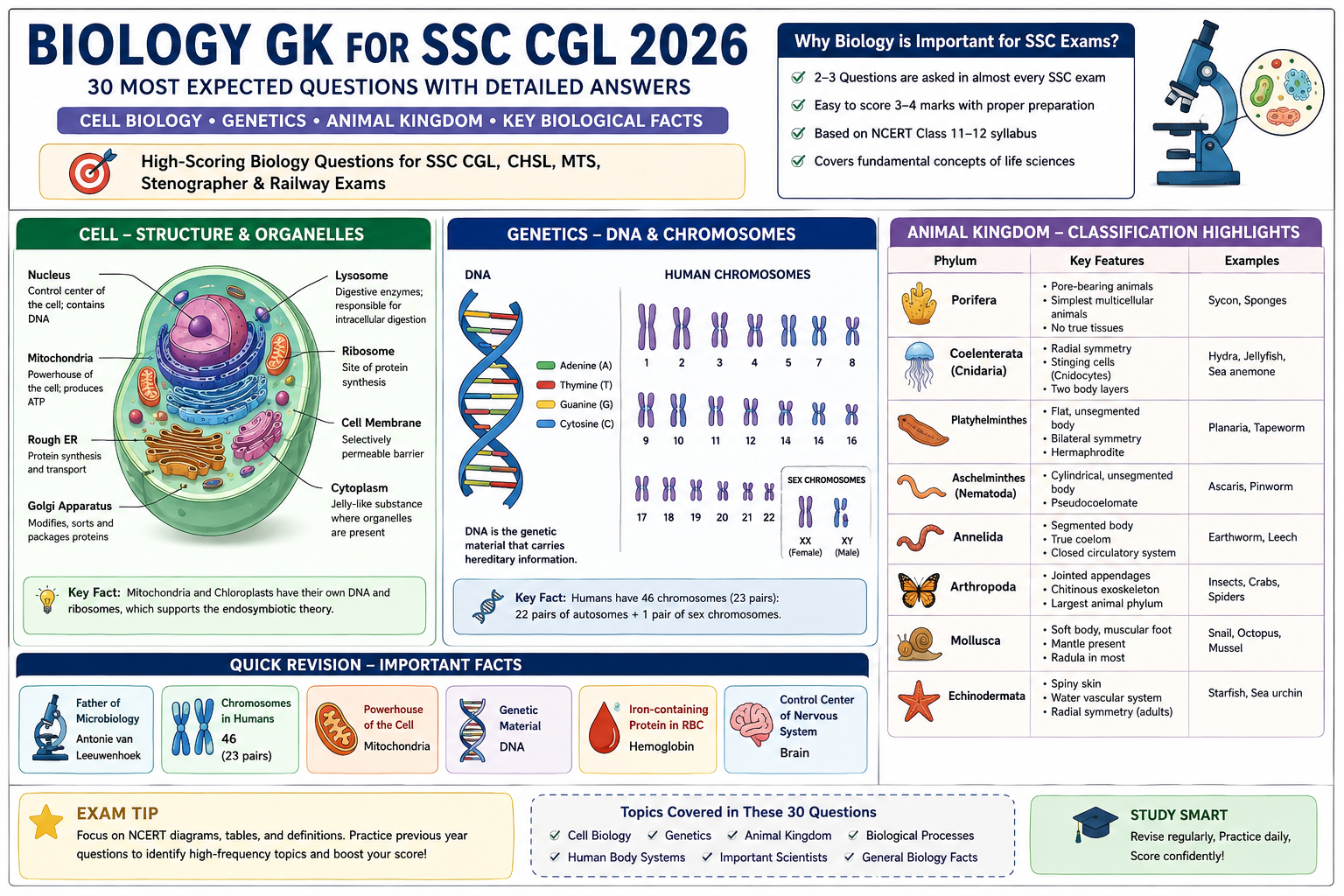
Quick-revision infographic: cell organelles, DNA & chromosomes, and animal kingdom classification for SSC CGL 2026.
Why Biology Is Important for SSC Exams
Biology is one of the highest-scoring sections in the General Awareness syllabus for SSC CGL, SSC CHSL, Railway NTPC, Group D, MTS, and several other competitive examinations. Every year, direct questions are asked from cell biology, genetics, human physiology, animal classification, microorganisms, and plant biology.
Biology questions are generally factual and concept-based, which means candidates who understand the basic scientific principles can answer them quickly during the exam. This guide covers the most exam-relevant topics: cell biology, genetics, DNA, chromosomes, cell organelles, animal kingdom classification, and important scientific discoveries.
Cell Biology: Most Important Biology GK Topics
Cell Biology forms one of the strongest areas of Biology GK. Candidates should focus on:
- Cell Theory
- Protoplasm
- Cell Membrane
- Osmosis and Plasmolysis
- Cell Wall
- Nucleus
- Ribosomes
- Cell Organelles
Students should understand the function of every major organelle, since direct questions are frequently asked using nicknames such as:
- Powerhouse of the Cell – Mitochondria
- Brain of the Cell – Nucleus
- Post Office of the Cell – Golgi Apparatus
- Suicidal Bags of the Cell – Lysosomes
- Father of Microbiology – Antonie van Leeuwenhoek
Genetics and DNA
Genetics remains one of the most frequently tested biology topics in SSC exams. Key areas to revise include:
- DNA Structure & the Watson-Crick double helix model
- Chromosomes and human chromosome number
- DNA Replication and the Cell Cycle
- S Phase of the cell cycle
- Helicase enzyme
- Histone Proteins
Cell Organelles and Their Functions
A functional understanding of each organelle helps answer direct as well as application-based questions:
| Organelle | Important Function |
|---|---|
| Nucleus | Controls cell activities |
| Mitochondria | Produces cellular energy (ATP) |
| Ribosomes | Protein synthesis |
| Golgi Apparatus | Packaging and transport |
| Lysosomes | Intracellular digestion |
| Rough Endoplasmic Reticulum | Protein synthesis |
| Smooth Endoplasmic Reticulum | Lipid synthesis |
Plastids — including chromoplasts and leucoplasts — also carry specialized functions and appear occasionally in exams. Lycopene gives tomatoes their red colour, and elaioplasts store oils and fats.
Animal Kingdom and Classification
Animal Classification is another high-weightage Biology topic. Candidates should understand body symmetry, germ layers, coelom, segmentation, notochord, and characteristic examples of each phylum.
| Phylum | Key Features | Examples |
|---|---|---|
| Porifera | Pore-bearing, simplest multicellular animals, no true tissues | Sycon, Sponges |
| Coelenterata (Cnidaria) | Radial symmetry, stinging cells (cnidocytes), two body layers | Hydra, Jellyfish, Sea anemone |
| Platyhelminthes | Flat, unsegmented body, bilateral symmetry, hermaphrodite | Planaria, Tapeworm |
| Aschelminthes (Nematoda) | Cylindrical, unsegmented body, pseudocoelomate | Ascaris, Pinworm |
| Annelida | Segmented body, true coelom, closed circulatory system | Earthworm, Leech |
| Arthropoda | Jointed appendages, chitinous exoskeleton, largest animal phylum | Insects, Crabs, Spiders |
| Mollusca | Soft body, muscular foot, mantle present, radula in most | Snail, Octopus, Mussel |
| Echinodermata | Spiny skin, water vascular system, radial symmetry (adults) | Starfish, Sea urchin |
High-Scoring Biology GK Facts
- Antonie van Leeuwenhoek is known as the Father of Microbiology.
- Robert Brown discovered the nucleus.
- Rudolf Virchow proposed that all cells arise from pre-existing cells.
- Watson and Crick proposed the double-helical structure of DNA.
- Mitochondria possess their own DNA.
- Ribosomes are formed in the nucleolus.
- Golgi Apparatus packages proteins.
- Lycopene gives tomatoes their red colour.
- Elaioplast stores oils and fats.
- DNA synthesis occurs during the S phase of the cell cycle.
Quick Revision Checklist
Before the examination, make sure you have revised:
- Cell Theory
- Cell Organelles
- DNA & RNA
- Chromosomes & Cell Division
- Genetics
- Animal Classification
- Human Chromosome Number
- Scientists and Their Discoveries
- Biological Terminology
Frequently Asked Questions
Who is called the Father of Microbiology?
Antonie van Leeuwenhoek is known as the Father of Microbiology.
How many chromosomes do humans have?
Humans possess 46 chromosomes arranged in 23 pairs.
Which organelle is known as the powerhouse of the cell?
Mitochondria is identified as the powerhouse of the cell.
Which organelle is called the brain of the cell?
The nucleus controls cellular activities and is commonly referred to as the brain of the cell.
During which phase does DNA replication occur?
DNA replication occurs during the S (Synthesis) phase of the cell cycle.
Which phylum is completely asymmetrical?
Porifera exhibits asymmetrical body organization.
Practice Biology GK Questions Now
Take a free, exam-specific Biology GK quiz on GK Capsule and track your accuracy instantly.
Start Biology QuizConclusion
Biology remains one of the easiest scoring subjects in SSC CGL, SSC CHSL, Railway NTPC, and other government examinations. The topics covered in this guide — cell biology, genetics, chromosomes, organelles, and animal classification — represent the core concepts most frequently tested. Regular revision and consistent MCQ practice can help you improve both speed and accuracy in the General Awareness section.