- Alluvial Soil
- Black Soil
- Red and Yellow Soil
- Laterite Soil
- Arid (Desert) Soil
- Forest and Mountain Soil
Soil Questions Link Geography, Agriculture & Economy
Soil questions are closely tied to agriculture, climate, natural vegetation, river systems, irrigation, and crop production — making them a recurring favourite across SSC, Railway, Banking, and UPSC exams.
Classification of Indian Soil Types
Use this table as your master reference — main region and major crops are the two facts asked most often.
| Soil Type | Main Region | Major Crops |
|---|---|---|
| Alluvial Soil | Northern Plains | Wheat, Rice, Sugarcane |
| Black Soil | Deccan Plateau | Cotton, Soybean |
| Red & Yellow Soil | Southern & Eastern India | Millets, Groundnut |
| Laterite Soil | Western Ghats, Eastern Ghats | Tea, Coffee, Rubber |
| Desert Soil | Rajasthan & Gujarat | Bajra, Barley |
| Forest Soil | Himalayan Region | Fruits, Tea, Spices |
The Six Major Soil Types, Explained
Distribution, characteristics, and crops for each soil type — organised the way exam questions actually ask about them.
1 Alluvial Soil
Formed by river-borne sediment deposition — the most fertile and widely distributed soil in India.
Distribution
- Punjab
- Haryana
- Uttar Pradesh
- Bihar
- West Bengal
- Assam
- Gujarat
- Coastal Plains
Characteristics
- Rich in potash and lime
- Poor in nitrogen and phosphorus
- High agricultural productivity
- Suitable for irrigation
Major Crops
- Wheat
- Rice
- Sugarcane
- Pulses
- Maize
- Jute
2 Black Soil
Also known as Regur Soil or Black Cotton Soil — develops from basaltic lava rock, famous for moisture retention.
Distribution
- Maharashtra
- Madhya Pradesh
- Gujarat
- Telangana
- Karnataka
Characteristics
- Clayey texture
- High water retention
- Rich in calcium and magnesium
- Cracks during summer
Major Crops
- Cotton
- Soybean
- Groundnut
- Wheat
- Sugarcane
3 Red & Yellow Soil
Gets its colour from iron oxide content in the parent rock.
Distribution
- Tamil Nadu
- Karnataka
- Andhra Pradesh
- Odisha
- Chhattisgarh
- Jharkhand
Characteristics
- Sandy to loamy texture
- Low nitrogen
- Low phosphorus
- Moderate fertility
Major Crops
- Groundnut
- Millets
- Pulses
- Cotton
- Tobacco
4 Laterite Soil
Develops in regions with high rainfall and high temperature, through a leaching process.
Distribution
- Kerala
- Karnataka
- Tamil Nadu
- Odisha
- Maharashtra
- Assam
Characteristics
- Rich in iron and aluminium
- Acidic in nature
- Poor in nitrogen
- Poor in humus
Major Crops
- Tea
- Coffee
- Rubber
- Cashew
- Coconut
5 Desert Soil
Found mainly in arid regions with very low rainfall.
Distribution
- Rajasthan
- Gujarat
- Haryana
Characteristics
- Sandy texture
- High salt content
- Low moisture
- Low organic matter
Major Crops
- Bajra
- Barley
- Mustard
6 Forest & Mountain Soil
Occurs in mountainous regions; texture and fertility vary with altitude.
Distribution
- Jammu & Kashmir
- Himachal Pradesh
- Uttarakhand
- Arunachal Pradesh
- Sikkim
Characteristics
- Rich in humus
- Acidic nature
- Suitable for plantations
Major Crops
- Tea
- Coffee
- Apples
- Spices
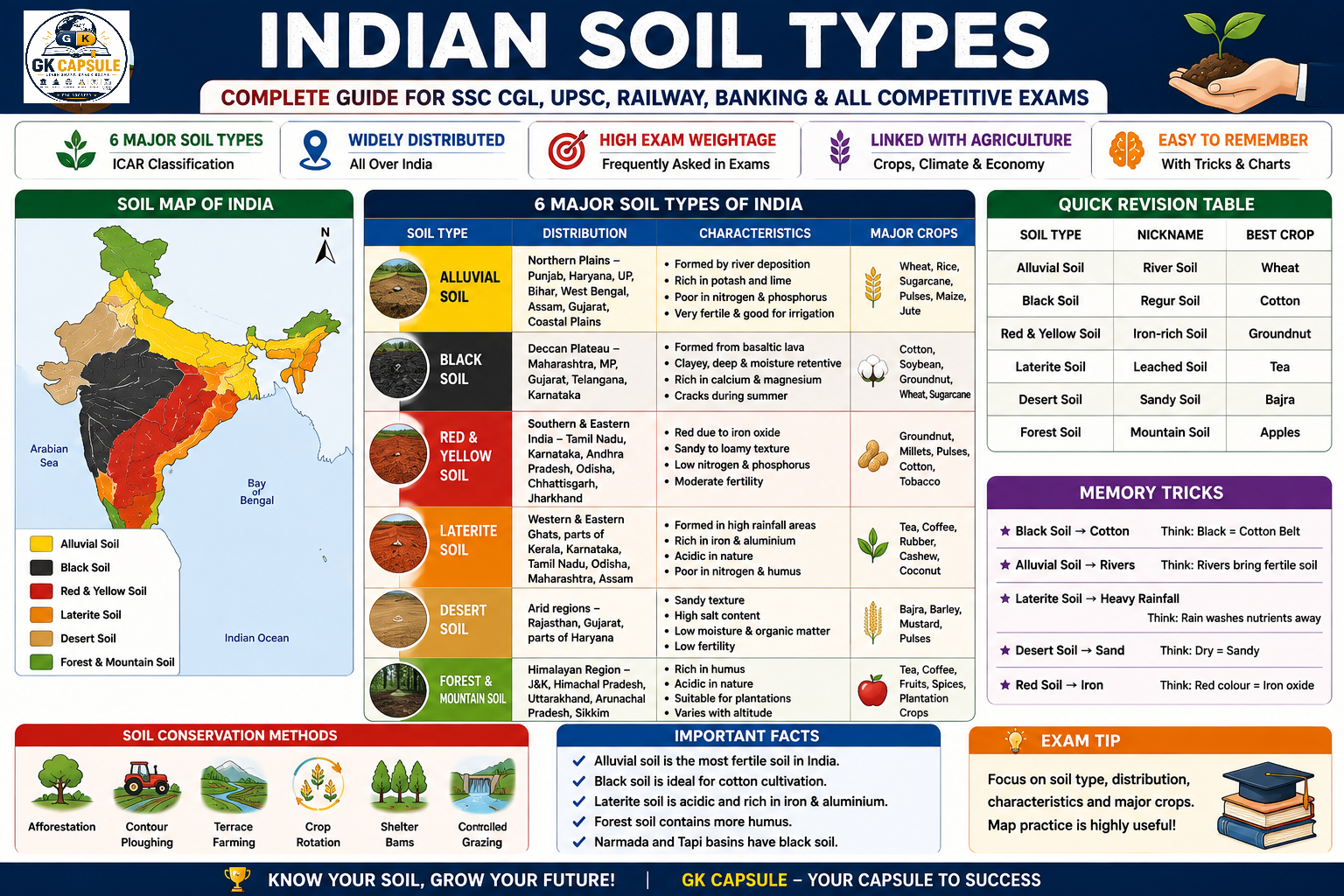
Quick Revision Table & Memory Tricks
Nicknames and one-line associations are the fastest way to recall the right soil type under exam pressure.
| Soil | Nickname | Best Crop |
|---|---|---|
| Alluvial | River Soil | Wheat |
| Black | Regur Soil | Cotton |
| Red | Iron-rich Soil | Groundnut |
| Laterite | Leached Soil | Tea |
| Desert | Sandy Soil | Bajra |
| Forest | Mountain Soil | Apples |
Soil Conservation Methods
These methods help reduce soil erosion and improve long-term fertility — occasionally asked as standalone one-liners.
Indian Soil Types MCQ
The first seven questions cover the exact topics SSC has asked in previous years; the rest are additional practice questions to round out your revision. Tap an option to check your answer.
Which soil is best suited for cotton cultivation?
Black soil is also known by which name?
Which soil type is richest in humus?
Which soil develops mainly due to river deposition?
Which soil dominates the Deccan Plateau?
Which soil type is most suitable for tea cultivation?
Which of these soils is acidic in nature?
Which soil type covers the largest area in India?
The Bangar and Khadar classification belongs to which soil?
What gives red soil its characteristic colour?
Which process leads to the formation of Laterite soil?
Desert soil is typically deficient in which of these?
Which soil is developed from basaltic lava rock?
Which soil type varies in texture with altitude in mountainous regions?
✅ Preparation Tips
- Learn soil distribution alongside a map
- Link each soil to its most-asked crop
- Revise conservation methods separately
- Practice previous-year SSC Geography questions
- Combine notes with MCQs for retention
⭐ Exam Tip
- Nickname + best crop pairs repeat often
- Black soil and cotton is nearly guaranteed
- Laterite vs. Forest soil (both acidic) is a common mix-up
- Use the memory tricks under exam time pressure
🎯 Focus Topics
- Alluvial vs. Black soil distribution
- Red & Laterite soil formation
- Desert & Forest soil crops
- Soil conservation methods
Frequently Asked Questions
Alluvial soil is considered the most fertile because it contains nutrients deposited by rivers and supports a wide variety of crops.
Black soil (Regur Soil) is ideal for cotton because of its high moisture-retaining capacity.
Red soil gets its colour from iron oxide.
Black soil is the dominant soil type in the Deccan Plateau.
Laterite soil and Forest soil are suitable for tea cultivation in high-rainfall regions.
Forest and Mountain Soil generally contains a high amount of organic matter and humus.
Alluvial soil is formed through river deposition.
Black soil develops deep cracks during the dry season due to its clay content.
Related Geography Topics
Consistent Revision = Exam Success
Take a free, timed Geography quiz on GK Capsule and see exactly how well you know India's soil types.
Practice Geography MCQs →