Constitutional Articles Are a High-Yield Polity Topic
Every year, competitive exams include questions on Fundamental Rights, Directive Principles, Constitutional Bodies, Emergency Provisions, and other Articles. Memorising the frequently asked ones is one of the fastest ways to secure marks in General Awareness.
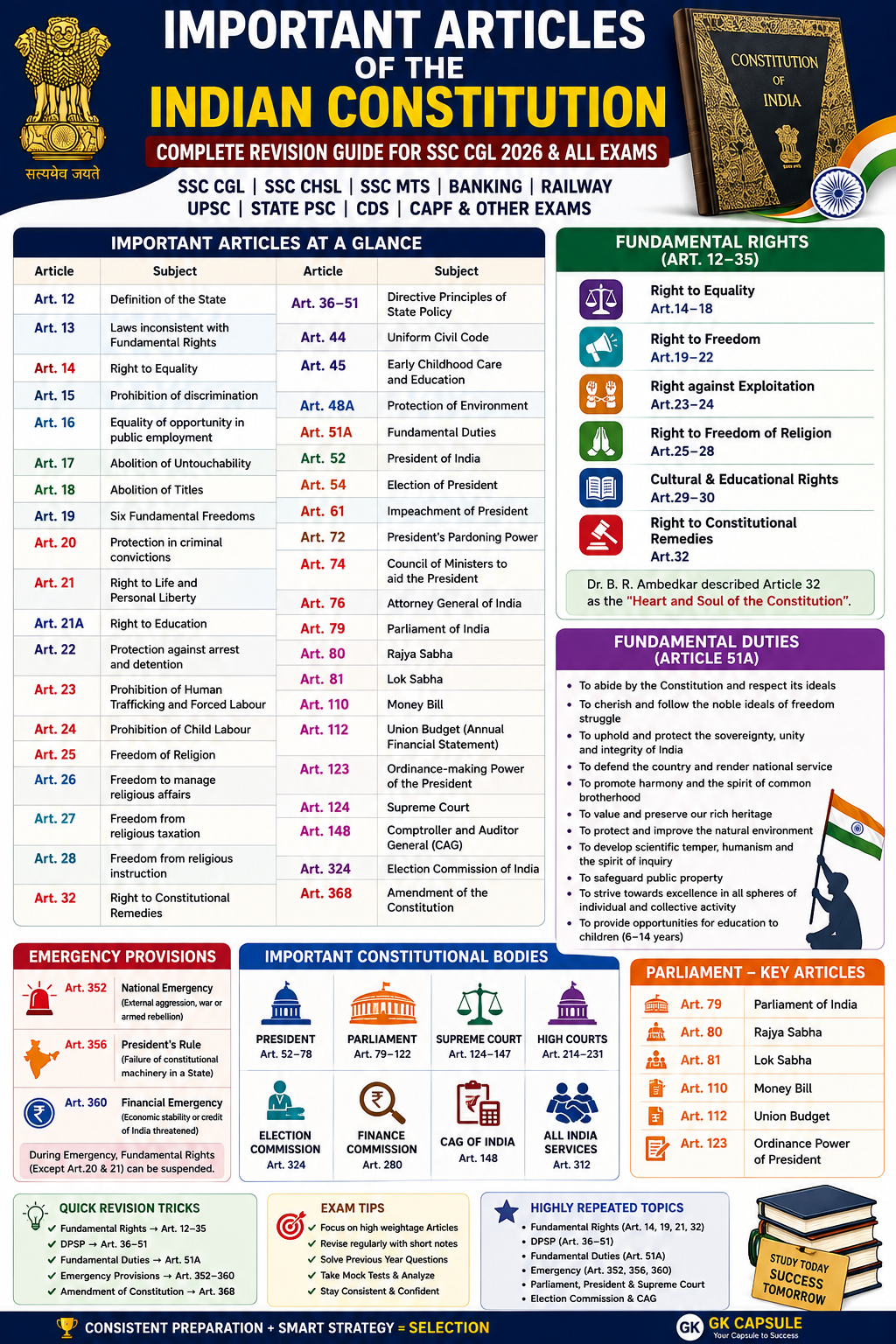
Complete List of Important Articles
Use this as your master revision table — scroll through and re-test yourself by covering the right-hand column.
| Article | Subject |
|---|---|
| Article 12 | Definition of the State |
| Article 13 | Laws inconsistent with Fundamental Rights |
| Article 14 | Right to Equality |
| Article 15 | Prohibition of discrimination |
| Article 16 | Equality of opportunity in public employment |
| Article 17 | Abolition of Untouchability |
| Article 18 | Abolition of Titles |
| Article 19 | Six Fundamental Freedoms |
| Article 20 | Protection in criminal convictions |
| Article 21 | Right to Life and Personal Liberty |
| Article 21A | Right to Education |
| Article 22 | Protection against arrest and detention |
| Article 23 | Prohibition of Human Trafficking and Forced Labour |
| Article 24 | Prohibition of Child Labour |
| Article 25 | Freedom of Religion |
| Article 26 | Freedom to manage religious affairs |
| Article 27 | Freedom from religious taxation |
| Article 28 | Freedom from religious instruction |
| Article 32 | Right to Constitutional Remedies |
| Article 36–51 | Directive Principles of State Policy |
| Article 44 | Uniform Civil Code |
| Article 45 | Early Childhood Care and Education |
| Article 48A | Protection of Environment |
| Article 51A | Fundamental Duties |
| Article 52 | President of India |
| Article 54 | Election of President |
| Article 61 | Impeachment of President |
| Article 72 | President's Pardoning Power |
| Article 74 | Council of Ministers to aid the President |
| Article 76 | Attorney General of India |
| Article 79 | Parliament of India |
| Article 80 | Rajya Sabha |
| Article 81 | Lok Sabha |
| Article 110 | Money Bill |
| Article 112 | Union Budget (Annual Financial Statement) |
| Article 123 | Ordinance-making Power of the President |
| Article 124 | Supreme Court |
| Article 148 | Comptroller and Auditor General (CAG) |
| Article 155 | Appointment of Governor |
| Article 165 | Advocate General |
| Article 214 | High Courts |
| Article 226 | Writ Jurisdiction of High Courts |
| Article 243 | Panchayati Raj |
| Article 280 | Finance Commission |
| Article 312 | All India Services |
| Article 324 | Election Commission of India |
| Article 352 | National Emergency |
| Article 356 | President's Rule |
| Article 360 | Financial Emergency |
| Article 368 | Amendment of the Constitution |
Quick Revision Tricks — Article Ranges
Group Articles by range instead of memorising each one in isolation. This is how most toppers hold the full list in their head.
Fundamental Rights Explained
Articles 12 to 35 form Part III of the Constitution — the single most tested block of Articles in SSC and Banking exams.
⚖️ Core Rights Every Aspirant Must Know
- Article 14 — guarantees equality before the law and equal protection of the laws
- Article 17 — abolishes untouchability in all its forms
- Article 19 — grants six fundamental freedoms: speech and expression, assembly, association, movement, residence, and profession
- Article 21 — guarantees the Right to Life and Personal Liberty
- Article 21A — makes education a Fundamental Right for children aged 6–14 years
- Article 25–28 — guarantee Freedom of Religion and related protections
Fundamental Rights vs. Fundamental Duties
A side-by-side quick guide makes it easy to remember which Article grants a right and which one sets out a citizen's duty — refer to the key breakdown below:
- Articles 12–35 — Fundamental Rights (Part III)
- Article 51A — Fundamental Duties (Part IV-A)
- Article 44 — Uniform Civil Code
- Article 48A — Protection of Environment
Directive Principles of State Policy & Fundamental Duties
Part IV covers the Directive Principles, and Part IV-A adds the Fundamental Duties — both are regularly tested alongside Fundamental Rights.
📜 Directive Principles (Articles 36–51)
- Article 44 — Uniform Civil Code
- Article 45 — Early Childhood Care and Education
- Article 48A — Protection of Environment
🤝 Fundamental Duties (Article 51A)
Article 51A lists the Fundamental Duties of every Indian citizen — a single-Article topic that is easy to score if revised once, thoroughly.
President, Parliament & the Judiciary
These Articles define how India's key constitutional offices are elected, empowered, and held accountable.
🏛️ President of India
- Article 52 — President of India
- Article 54 — Election of President
- Article 61 — Impeachment of President
- Article 72 — President's Pardoning Power
- Article 74 — Council of Ministers to aid the President
- Article 76 — Attorney General of India
- Article 123 — Ordinance-making Power of the President
🏢 Parliament of India
- Article 79 — Parliament of India
- Article 80 — Rajya Sabha
- Article 81 — Lok Sabha
- Article 110 — Money Bill
- Article 112 — Union Budget (Annual Financial Statement)
⚖️ Judiciary & Oversight Bodies
- Article 124 — Supreme Court
- Article 148 — Comptroller and Auditor General (CAG)
- Article 155 — Appointment of Governor
- Article 165 — Advocate General
- Article 214 — High Courts
- Article 226 — Writ Jurisdiction of High Courts
Panchayati Raj, Finance & Elections
These Articles set up the bodies that run local governance, financial distribution, and elections across India.
- Article 243 — Panchayati Raj
- Article 280 — Finance Commission
- Article 312 — All India Services
- Article 324 — Election Commission of India
Emergency Provisions & Constitutional Amendment
Articles 352 to 360 give the Union government special powers during a crisis — a compact, frequently repeated block.
🚨 Emergency Articles
- Article 352 — National Emergency
- Article 356 — President's Rule in a State
- Article 360 — Financial Emergency
Emergency Provisions at a Glance
National, State, and Financial Emergency provisions are easy to mix up — this reference guide helps candidates separate the three quickly:
- Article 352 — National Emergency
- Article 356 — President's Rule
- Article 360 — Financial Emergency
- Article 368 — Amendment Procedure
Most Frequently Asked Articles in SSC CGL
If your revision time is short, start here — these 13 Articles repeat across exam cycles more than any others.
Right to Constitutional Remedies
Lets citizens approach the Supreme Court directly to enforce Fundamental Rights — called the "Heart and Soul of the Constitution."
Right to Equality
Guarantees equality before the law and equal protection of the laws.
Abolition of Untouchability
Abolishes untouchability in all forms.
Six Fundamental Freedoms
Speech and expression, movement, association, residence, profession, and peaceful assembly.
Right to Life and Personal Liberty
One of the most cited Articles in Indian constitutional law.
Right to Education
Makes education a Fundamental Right for children aged 6–14 years.
Fundamental Duties
Lists the Fundamental Duties of every citizen.
Money Bill
Defines what qualifies as a Money Bill in Parliament.
Ordinance-making Power
Empowers the President to promulgate Ordinances when Parliament is not in session.
Election Commission of India
Provides for the constitutional body that conducts India's elections.
National Emergency
Empowers the President to declare a National Emergency.
President's Rule
Allows President's Rule to be imposed in a State.
Amendment of the Constitution
Specifies the procedure for amending the Constitution.
✅ Preparation Tips
- Revise constitutional Articles every week
- Practice previous-year Polity questions
- Focus on Articles frequently asked in SSC and Banking exams
- Use flashcards to memorise important Articles
- Attempt topic-wise mock tests regularly
⭐ Exam Tip
- Group Articles by range, not individually
- Learn the "why" behind each Article, not just the number
- Article 32, 21, and 368 are near-certain questions
- Short, repeated revision beats one long session
🎯 Focus Topics
- Fundamental Rights (12–35)
- Directive Principles (36–51)
- Fundamental Duties (51A)
- President & Parliament
- Supreme Court & High Courts
- Emergency Provisions
Frequently Asked Questions
Article 14 guarantees equality before the law and equal protection of the laws.
Article 17 abolishes untouchability in all its forms.
Article 21A provides free and compulsory education for children aged 6 to 14 years.
Article 32 is known as the Heart and Soul of the Constitution, a phrase used by Dr. B. R. Ambedkar.
Article 324 establishes the Election Commission of India.
Article 368 explains the amendment procedure for the Constitution.
Related Polity Topics
Consistent Revision = Exam Success
Take a free, timed Polity quiz on GK Capsule and lock in these Articles before exam day.
Practice Polity MCQs Now →