Quick Answer
The Governor General of India was the highest-ranking British official responsible for administering British territories in India from 1773 to 1858. After the Revolt of 1857, the office of Viceroy of India was introduced under the Government of India Act 1858 to represent the British Crown. From Lord Canning to Lord Mountbatten, Viceroys governed India until independence in 1947.
Timeline: Every Governor General & Viceroy at a Glance
Company rule (brass markers) gives way to Crown rule (red markers) at the Revolt of 1857 — the single most tested transition point in this topic.
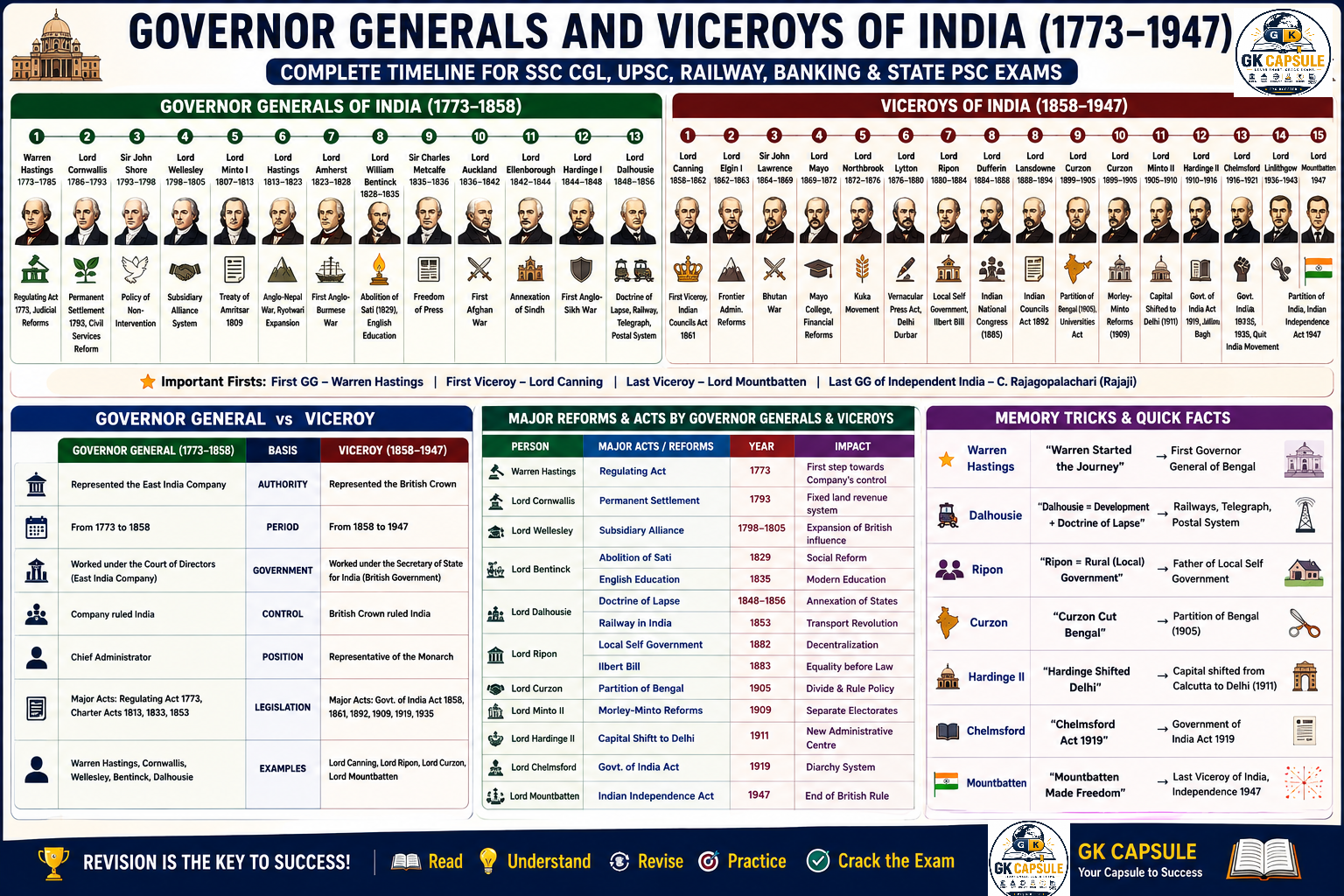
Why Governor Generals and Viceroys Are Important
Questions from this topic appear regularly because they are linked with:
Almost every competitive examination includes one or more questions from this topic.
Difference Between Governor General and Viceroy
| Governor General | Viceroy |
|---|---|
| Head of British administration in India | Representative of the British Crown |
| Office existed from 1773–1858 | Office existed from 1858–1947 |
| Worked under the East India Company | Worked directly under the British Government |
| Governor General after 1858 also acted as Viceroy | Continued until Indian Independence |
Complete List of Governor Generals of India
| Governor General | Tenure | Important Contributions |
|---|---|---|
| Warren Hastings | 1773–1785 | First Governor General of Bengal, Regulating Act, Judicial Reforms |
| Lord Cornwallis | 1786–1793 | Permanent Settlement, Civil Services Reform |
| Sir John Shore | 1793–1798 | Policy of Non-Intervention |
| Lord Wellesley | 1798–1805 | Subsidiary Alliance |
| Lord Minto I | 1807–1813 | Treaty of Amritsar (1809) |
| Lord Hastings | 1813–1823 | Anglo-Nepal War, Ryotwari Expansion |
| Lord Amherst | 1823–1828 | First Anglo-Burmese War |
| Lord William Bentinck | 1828–1835 | Abolition of Sati, English Education |
| Sir Charles Metcalfe | 1835–1836 | Freedom of Press |
| Lord Auckland | 1836–1842 | First Afghan War |
| Lord Ellenborough | 1842–1844 | Annexation of Sindh |
| Lord Hardinge I | 1844–1848 | First Anglo-Sikh War |
| Lord Dalhousie | 1848–1856 | Doctrine of Lapse, Railways, Telegraph, Postal System |
Major Governor Generals and Their Contributions
Warren Hastings
- First Governor General of Bengal.
- Introduced judicial reforms.
- Reorganized revenue administration.
- Associated with the Regulating Act of 1773.
Lord Cornwallis
Known as the Father of Civil Services in India.
- Permanent Settlement (1793)
- Judicial reforms
- Police reforms
Lord Wellesley
Introduced the famous Subsidiary Alliance System, which expanded British influence over Indian princely states.
Lord William Bentinck
One of the most important Governor Generals.
- Abolished Sati (1829)
- Suppressed Thuggee
- Promoted English Education
- Charter Act of 1833
Lord Dalhousie
Frequently asked in SSC examinations.
- Doctrine of Lapse
- First Railway (1853)
- Electric Telegraph
- Modern Postal System
- Public Works Department
Viceroys of India (1858–1947)
After the Revolt of 1857, the East India Company's rule ended. The British Crown appointed Viceroys to govern India.
| Viceroy | Tenure | Important Events |
|---|---|---|
| Lord Canning | 1858–1862 | First Viceroy, Indian Councils Act 1861 |
| Lord Elgin I | 1862–1863 | Frontier Administration |
| Sir John Lawrence | 1864–1869 | Bhutan War |
| Lord Mayo | 1869–1872 | Mayo College, Financial Decentralization |
| Lord Northbrook | 1872–1876 | Kuka Movement |
| Lord Lytton | 1876–1880 | Vernacular Press Act, Delhi Durbar |
| Lord Ripon | 1880–1884 | Local Self-Government, Ilbert Bill |
| Lord Dufferin | 1884–1888 | Formation of Indian National Congress (1885) |
| Lord Lansdowne | 1888–1894 | Indian Councils Act 1892 |
| Lord Elgin II | 1894–1899 | Famine Administration |
| Lord Curzon | 1899–1905 | Partition of Bengal (1905), Universities Act |
| Lord Minto II | 1905–1910 | Morley-Minto Reforms (1909) |
| Lord Hardinge II | 1910–1916 | Capital shifted to Delhi (1911) |
| Lord Chelmsford | 1916–1921 | Government of India Act 1919, Jallianwala Bagh |
| Lord Reading | 1921–1926 | Chauri Chaura Incident |
| Lord Irwin | 1926–1931 | Gandhi-Irwin Pact |
| Lord Willingdon | 1931–1936 | Civil Disobedience Movement |
| Lord Linlithgow | 1936–1943 | Government of India Act 1935 implementation, Quit India Movement |
| Lord Wavell | 1943–1947 | Wavell Plan, Shimla Conference |
| Lord Mountbatten | 1947 | Partition of India, Indian Independence Act |
Most Important Viceroys for SSC
Lord Ripon
Known as the Father of Local Self-Government in India.
- Local Self-Government
- Factory Act 1881
- Ilbert Bill
Lord Curzon
Frequently asked topics:
- Partition of Bengal (1905)
- Ancient Monuments Preservation Act
- Indian Universities Act
Lord Hardinge II
- Capital shifted from Calcutta to Delhi (1911)
- Delhi Durbar
Lord Chelmsford
- Government of India Act 1919
- Montagu-Chelmsford Reforms
- Jallianwala Bagh Massacre
Lord Mountbatten
- Last Viceroy of India
- Oversaw Partition of India
- Indian Independence Act 1947
Memory Tricks
Previous Year SSC Questions — Frequently Asked Topics
Quick Revision Table
| Governor General / Viceroy | Remember For |
|---|---|
| Warren Hastings | First Governor General of Bengal |
| Cornwallis | Permanent Settlement |
| Wellesley | Subsidiary Alliance |
| William Bentinck | Abolition of Sati |
| Dalhousie | Doctrine of Lapse |
| Canning | First Viceroy |
| Ripon | Local Self Government |
| Curzon | Partition of Bengal |
| Hardinge II | Capital shifted to Delhi |
| Chelmsford | Government of India Act 1919 |
| Mountbatten | Last Viceroy |
Frequently Asked Questions
Warren Hastings became the first Governor General of Bengal in 1773 under the Regulating Act. The first Governor-General of India under the Charter Act 1833 was Lord William Bentinck.
Lord Canning became the first Viceroy of India in 1858 after the British Crown assumed direct control.
Lord Cornwallis introduced the Permanent Settlement in Bengal in 1793.
Lord Dalhousie introduced the Doctrine of Lapse.
Lord Curzon carried out the Partition of Bengal in 1905.
Lord Hardinge II shifted the capital to Delhi in 1911.
Lord Mountbatten was the last Viceroy of British India before independence in 1947.
C. Rajagopalachari (Rajaji) was the last Governor-General of independent India and the only Indian to hold the office.
Conclusion
The Governor Generals and Viceroys of India played a significant role in shaping the political, administrative, educational, and social history of British India. For SSC CGL, UPSC, Railway, Banking, and State PSC aspirants, understanding their reforms, important Acts, and historical events is essential. Regular revision, timeline-based learning, and solving previous-year questions will help you remember key facts more effectively.