Ancient History GK: Gupta Era Questions for SSC CGL, CHSL & Railway Exams
Table of Contents
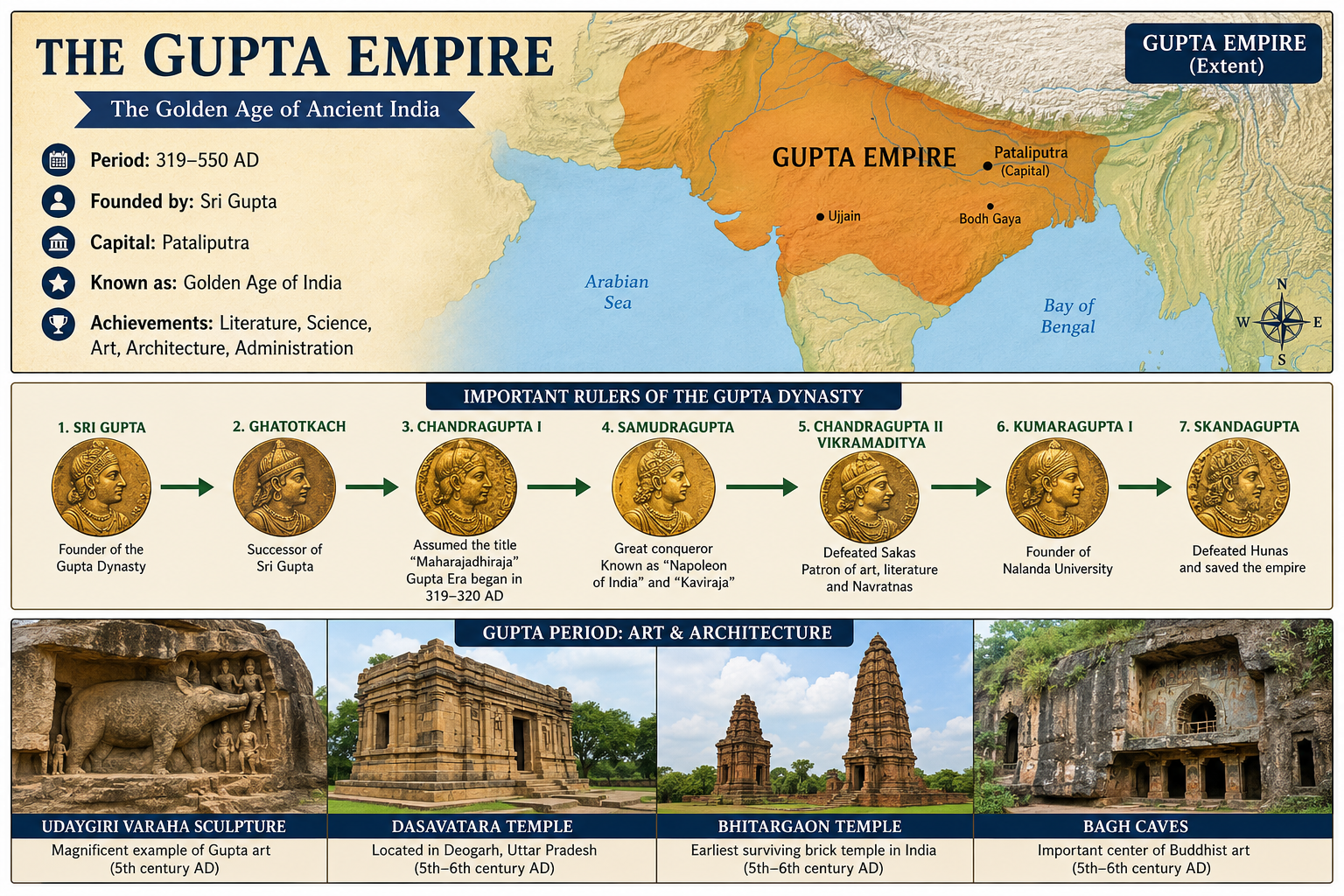
The Gupta Empire occupies an important place in Ancient History GK because it is one of the most frequently tested topics in competitive examinations. Questions are commonly asked about Gupta rulers, administrative divisions, coinage, literature, inscriptions, temples, taxation, and the decline of the empire.
Candidates preparing for SSC CGL, SSC CHSL, Railway NTPC, Railway Group D, and other government examinations should understand these topics because they regularly appear in General Awareness sections.
Why the Gupta Era Is Important in Ancient History GK
The Gupta period is widely known as the Golden Age of Ancient India in history textbooks. Examination questions usually focus on factual information rather than lengthy historical events.
Important areas include:
- Gupta rulers and their achievements
- Titles adopted by kings
- Coin types and coinage
- Court scholars and Navratnas
- Administrative officers and divisions
- Temples and architecture
- Taxation system
- Chinese traveller Fa-Hien
- Decline of the empire
Rise of the Gupta Dynasty
The foundation of the Gupta Dynasty marks the beginning of one of India's most prosperous periods.
- Sri Gupta founded the Gupta Dynasty
- Ghatotkach succeeded Sri Gupta
- Chandragupta I assumed the title Maharajadhiraja
- The Gupta Era began in 319–320 AD
- Chandragupta I strengthened the dynasty through his marriage to Kumaradevi of the Lichchavi family
Exam Tip: The year 319–320 AD is the most important date for Gupta Era questions. This marks the beginning of the Gupta chronology used in most competitive exams.
Gupta Coinage
Coinage is an important topic in SSC and Railway examinations. Understanding Gupta coins helps identify rulers and their achievements.
- Gupta gold coins were called Dinars
- Samudragupta issued the famous Veena (Lyrist) type coins
- The Marriage Coin depicts Chandragupta I and Kumaradevi
- Chandragupta II became the first Gupta ruler to issue silver coins after defeating the Sakas
- Important coin varieties include Lion Slayer, Rhino Slayer, and Asvamedha types
Samudragupta and His Military Achievements
Samudragupta is one of the most celebrated rulers in Ancient Indian history, known for his extensive military campaigns.
Important examination facts include:
- His achievements are described in the Prayag Prasasti
- The inscription was composed by Harisena
- Historian V. A. Smith referred to Samudragupta as the "Napoleon of India"
- He held titles including Kaviraja, Param Bhagavat, and Sarva-raj-ochchetta
- His Veena coins symbolize his patronage of arts and culture
These facts frequently appear in 1-mark multiple-choice questions in SSC and Railway exams.
Chandragupta II (Vikramaditya) and the Golden Age
Chandragupta II, also known as Vikramaditya, ruled during one of the most prosperous periods of the Gupta Empire. His reign witnessed significant achievements in military, culture, and administration.
- He defeated the Sakas, expanding Gupta territory
- He introduced silver coinage, an economic innovation
- The Mehrauli Iron Pillar inscription is associated with him
- Chinese pilgrim Fa-Hien visited India during his reign and documented Gupta prosperity
- His court included the famous Navratnas (nine scholars)
Fa-Hien's account provides external historical evidence about Gupta administrative efficiency and cultural achievements.
Gupta Literature and the Navratnas
Literature and arts flourished magnificently during the Gupta period, earning it the title of the Golden Age of Ancient India. The court of Chandragupta II (Vikramaditya) at Ujjain was particularly famous for hosting the Navratnas (Nine Jewels).
Key literary figures and their famous works frequently asked in SSC CGL & Railway exams include:
- Kalidasa: Known as the Shakespeare of India. His masterworks include:
- Dramas: Abhijnanashakuntalam, Malavikagnimitram, Vikramorvasiyam
- Epic Poems: Raghuvamsa, Kumarasambhava
- Lyric Poems: Meghaduta, Ritusamhara
- Dhanvantri: Renowned court physician and master of Ayurveda, considered the father of Indian medicine.
- Varahamihira: Great astronomer and mathematician who authored Brihat Samhita, Panchasiddhantika, and Brihat Jataka.
- Amarasimha: Famous Sanskrit lexicographer who compiled the Amarakosha vocabulary dictionary.
- Harisena: Court poet of Samudragupta who composed the famous Prayag Prasasti (Allahabad Pillar Inscription) in Sanskrit.
- Aryabhata: Legendary mathematician and astronomer (contemporary) who wrote Aryabhatiya and Surya Siddhanta. He formulated the concept of zero, calculated the exact value of \(\pi\), and explained the true cause of solar and lunar eclipses.
- Vishakhadatta: Authored historical dramas Mudrarakshasa (detailing Chandragupta Maurya's rise) and Devichandraguptam.
- Sudraka: Wrote the famous play Mrichchhakatika (The Little Clay Cart).
- Vishnu Sharma: Authored Panchatantra, the famous collection of animal fables.
Gupta Empire Administration
The Gupta administrative system was decentralized compared to the highly centralized Mauryan administration, giving significant autonomy to provincial officers and local assemblies.
Administrative Units:
| Unit Level | Name of Division | Head Officer / Governor |
|---|---|---|
| Province | Bhukti (or Desha) | Uparika (or Goptri) |
| District | Vishaya | Vishayapati |
| Sub-District | Vithi | Vithipati |
| Village | Gram | Gramika / Gramadhyaksha |
Important Administrative Titles for Competitive Exams:
- Sandhivigrahika: Minister for Foreign Affairs, War, and Peace (e.g., Harisena).
- Kumaramatyas: High-ranking cadre of administrative officers serving directly under the king.
- Maha-dandanayaka: Chief Judicial Officer and Army Commander.
- Mahapratihara: Chief Marshal of the Royal Palace Guard.
- Mahapilupati: Commander of the Elephant Corps.
Gupta Economy and Taxation System
Agriculture was the main pillar of the Gupta economy. Trade and commerce reached international heights, with flourishing guilds (Srenis) and extensive monetary transactions.
Major Types of Taxes:
- Bhaga: King's standard share of agricultural produce, fixed at 1/6th of total crop yield.
- Bhoga: Periodic supply of fruits, firewood, and flowers provided by villagers to the king.
- Kara: Periodic tax levied on land and villagers.
- Hiranya: Tax paid exclusively in cash/gold.
- Vishti: Forced unpaid labor exacted from villagers for royal or state projects (frequently asked in SSC CGL).
- Bali: Mandatory religious or royal tribute tax.
Key Maritime Trade Ports: Tamralipti on the Bengal coast handled trade with South-East Asia and China, while Bharuch (Barygaza) on the Gujarat coast handled trade with the Mediterranean and Western Asia.
Gupta Art, Architecture and Temples
The Gupta period marked the beginning of free-standing structural Hindu temple architecture in North India, giving birth to the early Nagara Style of architecture.
Famous Temples & Monuments:
- Dasavatara Temple (Deogarh, UP): One of the earliest surviving Panchayatan-style stone temples dedicated to Lord Vishnu.
- Bhitargaon Temple (Kanpur, UP): The oldest surviving terracotta brick temple featuring a developed high shikhara.
- Udayagiri Cave Reliefs (Vidisha, MP): Famous rock-cut cave art depicting the massive Varaha Avatar (boar incarnation of Lord Vishnu) rescuing Mother Earth.
- Bagh Caves (Dhar, MP): Group of nine rock-cut Buddhist caves celebrated for vibrant mural wall paintings.
- Ajanta Caves (Cave 16 & 17, Maharashtra): Renowned world heritage caves containing exquisite fresco paintings and Jataka tale illustrations created during the Gupta-Vakataka era.
- Sarnath Seated Buddha: Masterpiece of Gupta sculpture depicting Lord Buddha in the Dharmachakra Pravartana Mudra (First Sermon).
⚡ Quick Revision Summary: Top Gupta Era Exam Facts
- Gupta Era Founder: Sri Gupta | Era Started: 319–320 AD by Chandragupta I
- Napoleon of India: Samudragupta (named by V. A. Smith; Prayag Prasasti by Harisena)
- First Silver Coins Ruler: Chandragupta II Vikramaditya (after defeating Sakas)
- Gold Coins Name: Dinars | Silver Coins Name: Rupaka
- Nalanda University Founder: Kumaragupta I (Mahendraditya)
- Defeated Hunas Invasion: Skandagupta (Bhitari Pillar Inscription)
- Chinese Pilgrim Visit: Fa-Hien visited during Chandragupta II's reign
Frequently Asked Questions (FAQs)
1. Why is the Gupta Empire called the Golden Age of Ancient India?
It is called the Golden Age because of unprecedented advancements in science, mathematics, astronomy, Sanskrit literature, coin minting, trade prosperity, and structural temple architecture.
2. Which Gupta ruler started the Gupta Era?
Chandragupta I started the Gupta Era in 319–320 AD when he assumed the grand title of Maharajadhiraja.
3. What were Gupta gold and silver coins called?
Gupta gold coins were called Dinars while silver coins were known as Rupaka.
4. Who was called the Napoleon of India and why?
Historian V. A. Smith called Samudragupta the "Napoleon of India" because of his unbroken string of military conquests detailed in the Prayag Prasasti inscription composed by Harisena.
5. Who were the Navratnas in Chandragupta II's court?
The nine court scholars were Kalidasa, Dhanvantri, Varahamihira, Amarasimha, Vararuchi, Ghatakarpara, Kshapanaka, Shanku, and Vetalbhatta.
6. What was the standard land tax rate during the Gupta period?
The standard land revenue tax was called Bhaga, which was set at 1/6th (16.66%) of total agricultural produce.
Master History GK for Competitive Exams
Revising the Gupta Era with clear timeline understanding and PYQ practice is the fastest way to score full marks in Ancient History for SSC CGL, CHSL, Railway, and State PSC exams.
Practice History PYQ MCQs Now → Full History Study Guide →