Table of Contents
Introduction to Buddhism and Jainism
Buddhism and Jainism are two of the most significant religious and philosophical traditions to emerge from ancient India during the 6th century BCE. Both developed as responses to the prevailing religious practices of the time and offered alternative paths toward spiritual liberation. These traditions have profoundly influenced Indian civilization and continue to be important for understanding cultural, philosophical, and historical developments.
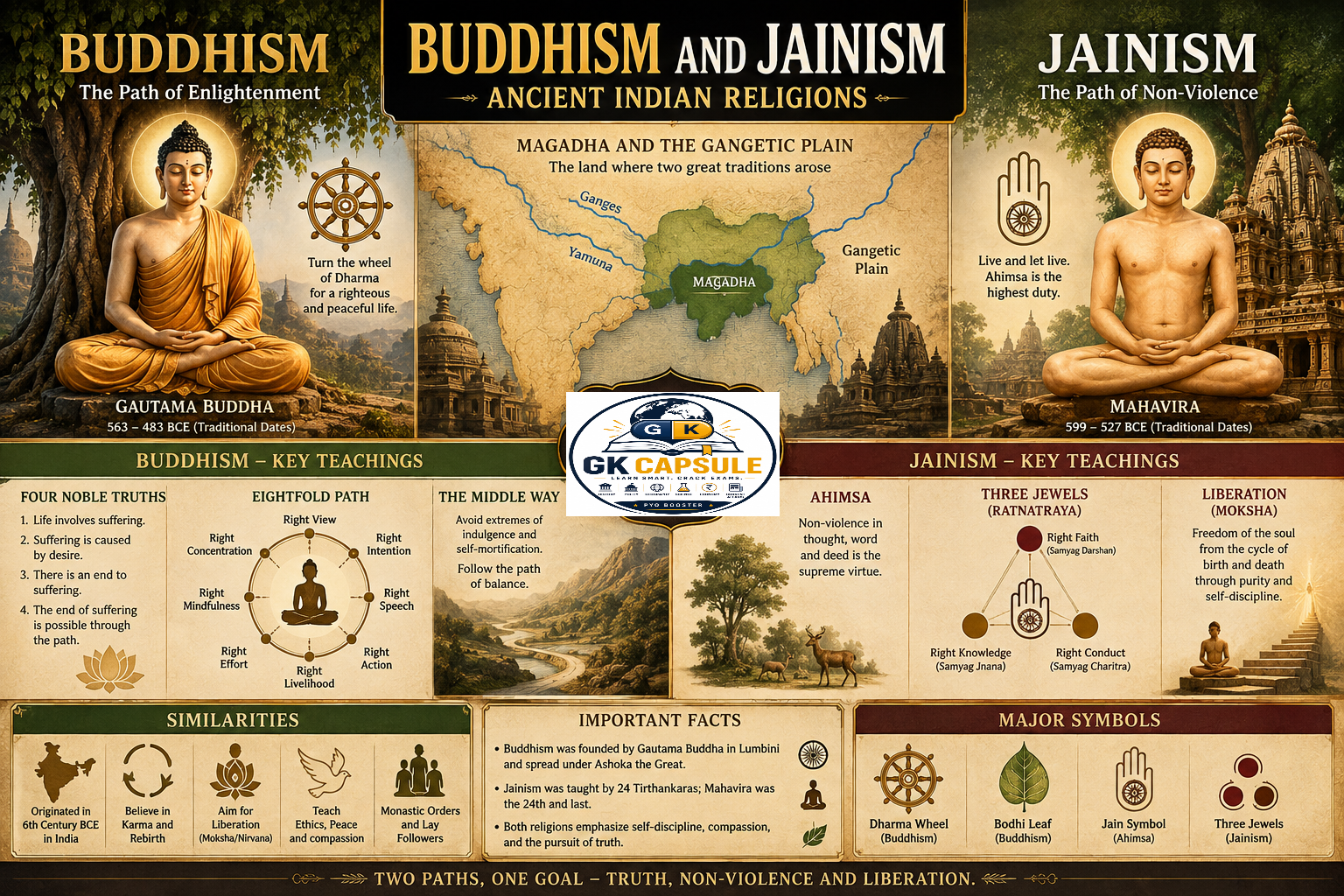
Complete Infographic Overview: Gautama Buddha, Mahavira, Noble Truths, Eightfold Path & Jain Vows for Competitive Exams
Why Buddhism and Jainism Are Important for Competitive Exams
Questions on Buddhism and Jainism regularly appear in competitive examinations like SSC CGL, UPSC, Banking, Railway, and State PSC exams. These questions typically test:
- Founders and important historical figures
- Key teachings and doctrines (Four Noble Truths, Ahimsa, etc.)
- Important places and events
- Councils and their significance
- Major sects and schools
- Comparisons between the two traditions
Exam Strategy: Build separate memory chains for each tradition. For Buddhism: Buddha → Four Noble Truths → Eightfold Path → Middle Way → Sangha → Councils. For Jainism: Mahavira → 24th Tirthankara → Ahimsa → Five Vows → Triratna → Digambara/Svetambara.
Historical Background of Buddhism and Jainism
The 6th century BCE in India witnessed significant intellectual and social transformation. This period, often called the "Second Urbanization," saw the rise of new political formations, increased trade, growth of urban centers, and the emergence of critical philosophical movements that questioned established religious orthodoxy.
600-500 BCE
Period of Emergence: Both Buddhism and Jainism developed during this period as part of the broader Śramaṇa movement, which emphasized personal spiritual effort over ritual sacrifice.
563 BCE (Traditional)
Birth of Gautama Buddha: Born as Siddhartha Gautama in Lumbini, he would later become the Buddha.
540-468 BCE
Life of Mahavira: Vardhamana Mahavira, the 24th Tirthankara of Jainism, lived and taught during this period.
483 BCE
First Buddhist Council: Held at Rajagriha shortly after the Buddha's Mahaparinirvana.
Social Context: Both movements emerged during a period when kshatriya (warrior) communities were gaining prominence and challenging Brahminical authority. The teachings appealed particularly to merchants, traders, and urban dwellers who were excluded from or dissatisfied with the Vedic ritual system.
Buddhism
Buddhism, founded by Gautama Buddha, is one of the world's major religions and philosophical traditions. It emphasizes the Four Noble Truths, the Noble Eightfold Path, and the Middle Way between indulgence and asceticism.
Gautama Buddha & Buddhist Philosophy Infographic
Visual breakdown of Siddhartha Gautama's life, Enlightenment at Bodh Gaya, First Sermon at Sarnath, and core doctrines.
Life of Gautama Buddha
Birth (563 BCE): Siddhartha Gautama was born in Lumbini (modern Nepal) to King Suddhodana of the Shakya clan.
The Four Sights: At age 29, Siddhartha encountered an old man, a sick man, a corpse, and an ascetic, which led him to question the nature of existence.
Renunciation: Leaving his palace, wife (Yashodhara), and son (Rahula), he became a wandering ascetic.
Enlightenment (528 BCE): After six years of extreme asceticism, he renounced harsh practices and attained enlightenment (Nirvana) while meditating under a Bodhi tree in Bodh Gaya.
First Sermon (Dhammacakkappavattana Sutta): At Sarnath, he taught the Four Noble Truths to his first five disciples.
Mahaparinirvana (483 BCE): He attained final Nirvana at Kushinagar at age 80.
Important Buddhist Sites: Lumbini (Birth), Bodh Gaya (Enlightenment), Sarnath (First Sermon), Kushinagar (Death/Mahaparinirvana)
Four Noble Truths (Arya Satya)
The foundation of Buddhist philosophy, taught by Buddha in his first sermon at Sarnath.
| No. | Noble Truth | Pali Term | Meaning | Analogy |
|---|---|---|---|---|
| 1 | Truth of Suffering | Dukkha | Existence involves suffering, impermanence, and unsatisfactoriness | Diagnosis of disease |
| 2 | Truth of the Cause | Samudaya | Suffering arises from craving (Tanha) and ignorance (Avijja) | Cause of disease |
| 3 | Truth of Cessation | Nirodha | Suffering can cease through eliminating craving | Possibility of cure |
| 4 | Truth of the Path | Magga | The Noble Eightfold Path leads to cessation of suffering | Prescription for cure |
Exam Tip: Memorize: Dukkha → Samudaya → Nirodha → Magga. Remember as medical analogy: Diagnosis → Cause → Cure → Treatment.
Noble Eightfold Path (Ariya Atthangika Magga)
The practical path to liberation from suffering, divided into three categories:
1. Wisdom (Prajñā)
- Right View (Sammā Diṭṭhi): Understanding the Four Noble Truths
- Right Intention (Sammā Saṅkappa): Commitment to ethical and mental development
2. Ethical Conduct (Śīla)
- Right Speech (Sammā Vācā): Truthful, non-harmful speech
- Right Action (Sammā Kammanta): Ethical conduct (non-violence, honesty, etc.)
- Right Livelihood (Sammā Ājīva): Ethical means of living
3. Mental Discipline (Samādhi)
- Right Effort (Sammā Vāyāma): Cultivating wholesome states
- Right Mindfulness (Sammā Sati): Awareness of body, feelings, mind, phenomena
- Right Concentration (Sammā Samādhi): Developing deep meditation states
Key Concepts
- Middle Way (Majjhima Patipada): Avoid extremes of indulgence and asceticism
- Anatta (Non-Self): Doctrine that there is no permanent, unchanging self
- Sangha: Buddhist monastic community
- Dharma: Buddha's teachings
Buddhist Councils
Four major councils were held to preserve, recite, and codify Buddhist teachings:
| Council | Year (Approx.) | Location | Patron | Significance |
|---|---|---|---|---|
| First | 483 BCE | Rajagriha | King Ajatashatru | Recitation of Vinaya and Sutta by Ananda and Upali |
| Second | 383 BCE | Vaishali | King Kalasoka | Schism over 10 points of Vinaya; Division into Sthaviravada and Mahasanghika |
| Third | 250 BCE | Pataliputra | Emperor Ashoka | Purification of Sangha; Abhidhamma Pitaka compiled; Missionaries sent abroad |
| Fourth | 1st Century CE | Kashmir | King Kanishka | Mahayana Buddhism codified; Sanskrit used; Vasumitra and Asvaghosha presided |
Exam Importance: Third Council associated with Ashoka, Fourth Council associated with Kanishka. Remember sequence: Rajagriha → Vaishali → Pataliputra (Ashoka) → Kashmir (Kanishka).
Important Buddhist Texts, Symbols and Schools
Tripiṭaka (Three Baskets):
- Vinaya Piṭaka: Monastic rules and regulations
- Sutta Piṭaka: Discourses of Buddha (Dhammapada most famous)
- Abhidhamma Piṭaka: Philosophical analysis
Major Schools:
Theravada (Hinayana)
- "Doctrine of the Elders"
- Emphasizes individual liberation
- Pali canon
- Sri Lanka, Thailand, Myanmar
Mahayana
- "Great Vehicle"
- Bodhisattva ideal (enlightenment for all)
- Sanskrit texts
- China, Japan, Korea
Buddhist Symbols: Dharma Chakra (Wheel of Law), Bodhi Tree, Stupa, Lotus, Footprints of Buddha
Jainism
Jainism is one of India's oldest religions, emphasizing non-violence (Ahimsa), asceticism, and the purification of the soul through right conduct.
Lord Mahavira & Jainism Core Doctrines Infographic
Detailed visual guide covering the 24th Tirthankara, Kevala Jnana, Ahimsa, Triratna (Three Jewels), and Digambara vs Svetambara sects.
Life and Teachings of Mahavira
Birth: Vardhamana Mahavira was born in 540 BCE in Kundagrama (Vaishali), Bihar.
Family: Born to King Siddhartha and Queen Trishala of the Ikshvaku dynasty.
Renunciation: At age 30, he renounced worldly life and practiced severe austerities for 12 years.
Kevala Jnana: At age 42, he attained omniscience (Kevala Jnana) under a Sal tree.
Teaching Career: He taught for 30 years and organized the Jain Sangha.
Nirvana: Attained Moksha at Pavapuri in 468 BCE at age 72.
Key Concept: Mahavira was the 24th Tirthankara (ford-maker or spiritual teacher) in Jain tradition. Previous Tirthankaras include Rishabhanatha (1st) and Parshvanatha (23rd).
Five Great Vows (Mahavratas) of Jainism
Fundamental ethical principles followed by Jain ascetics:
| Vow | Sanskrit/Prakrit | Meaning | Explanation |
|---|---|---|---|
| Non-violence | Ahimsa | No harm to living beings | Most important principle; extends to thoughts, words, actions |
| Truth | Satya | Truthfulness | Speaking truth that is non-harmful and beneficial |
| Non-stealing | Asteya | Not taking what is not given | Avoiding theft and exploitation |
| Celibacy | Brahmacharya | Sexual restraint | For ascetics: complete celibacy; for laypersons: marital fidelity |
| Non-possession | Aparigraha | Non-attachment | Renouncing property and possessions; minimizing needs |
Triratna (Three Jewels): Right Faith (Samyag Darshana), Right Knowledge (Samyag Jnana), Right Conduct (Samyag Charitra) - necessary for liberation.
Jain Councils, Sects and Important Texts
Jain Councils:
- First Council (300 BCE): Patliputra, presided by Sthulabhadra, compiled 12 Angas
- Second Council (512 CE): Vallabhi, presided by Devardhi Ksamasramana, final compilation of Jain canons
Major Jain Sects
Digambara (Sky-clad)
- Monks renounce all possessions including clothes
- Believe women cannot attain Moksha directly
- Bhadrabahu led this sect
- Mainly in Karnataka, Maharashtra
- Believe original scriptures lost
Svetambara (White-clad)
- Monks wear white clothes
- Believe women can attain Moksha
- Sthulabhadra led this sect
- Mainly in Gujarat, Rajasthan
- Preserve 45 Agama texts
Important Jain Texts:
- Agamas: Compilations of Mahavira's teachings
- Angas: 12 main texts containing teachings
- Kalpasutra: Biography of Mahavira by Bhadrabahu
- Tattvartha Sutra: Philosophical text by Umaswati
Important Doctrines: Anekantavada (many-sidedness of reality), Syadvada (theory of conditioned predication), Karma theory (attraction of karmic particles to soul), Kevala Jnana (perfect knowledge).
Buddhism vs Jainism
| Aspect | Buddhism | Jainism |
|---|---|---|
| Founder | Gautama Buddha | Mahavira (24th Tirthankara) |
| Origin | 6th century BCE | Pre-historic, systematized 6th century BCE |
| Ultimate Goal | Nirvana (extinction of suffering) | Moksha (liberation of soul) |
| Concept of Soul | Anatta (no permanent self) | Eternal individual soul (Jiva) |
| Path to Liberation | Middle Way, Eightfold Path | Three Jewels, Five Great Vows |
| Attitude to Asceticism | Moderate (rejected extreme asceticism) | Extreme asceticism emphasized |
| Concept of God | Silent on creator God | No creator God; Tirthankaras as teachers |
| Karma Theory | Psychological and ethical consequences | Physical particles attaching to soul |
| Language of Scriptures | Pali (Theravada), Sanskrit (Mahayana) | Ardhamagadhi Prakrit |
| Major Sects | Theravada, Mahayana, Vajrayana | Digambara, Svetambara |
Similarities Between Buddhism and Jainism
- Both emerged in 6th century BCE as Śramaṇa movements
- Rejected Vedic authority and ritualism
- Opposed caste system (though not completely)
- Emphasized ethical conduct over rituals
- Accepted concepts of Karma and rebirth
- Founded monastic orders (Sangha)
- Used vernacular languages rather than Sanskrit
Differences Between Buddhism and Jainism
- Soul: Buddhism denies permanent soul (Anatta); Jainism accepts eternal soul
- Asceticism: Buddha rejected extreme asceticism; Mahavira practiced and advocated it
- Non-violence: Jainism emphasizes Ahimsa more rigorously
- Spread: Buddhism spread internationally; Jainism remained mostly in India
- Scriptures: Buddhist Tripitaka vs Jain Agamas
Spread of Buddhism and Jainism
Spread of Buddhism
- Ashoka (3rd century BCE): Sent missionaries to Sri Lanka (Mahinda), Central Asia, Greece
- Kanishka (1st century CE): Promoted Buddhism; 4th Council; spread to Central Asia
- Silk Route: Buddhism spread to China, Korea, Japan via trade routes
- Southeast Asia: Spread to Myanmar, Thailand, Cambodia, Vietnam
- Decline in India: After 12th century, due to Muslim invasions and revival of Hinduism
Spread of Jainism
- Initial Spread: Mainly in Magadha, Anga, and other eastern regions
- Western India: Spread to Gujarat, Rajasthan under royal patronage
- Southern India: Spread to Karnataka, Tamil Nadu
- Merchant Community: Jain traders helped spread the religion
- Limited International Spread: Mostly confined to Indian subcontinent
Patronage: Buddhism was patronized by Ashoka, Kanishka, Harsha. Jainism was patronized by Chandragupta Maurya (in his later life), Kharavela of Kalinga, Rashtrakutas, and several South Indian dynasties.
Important Terms for Exams
High-Value Keywords
Memorable One-Liners
Buddhism
- Buddha → Gautama Siddhartha
- Birth → Lumbini
- Enlightenment → Bodh Gaya
- First Sermon → Sarnath (Dhammacakka)
- Death → Kushinagar
- Core Teaching → Four Noble Truths
- Path → Noble Eightfold Path
- Doctrine of Self → Anatta (No-self)
Jainism
- Founder → Mahavira (24th Tirthankara)
- Birth → Kundagrama (Vaishali)
- Kevala Jnana → Omniscience
- Moksha → Pavapuri
- Main Principle → Ahimsa (Non-violence)
- Vows → Five Great Vows
- Jewels → Triratna
- Sects → Digambara & Svetambara
Buddhism and Jainism MCQs
Q1. Where was Gautama Buddha born?
A. Bodh Gaya
B. Lumbini
C. Sarnath
D. Kushinagar
Q2. Buddha attained enlightenment under which tree?
A. Banyan
B. Peepal (Bodhi)
C. Ashoka
D. Mango
Q3. What does 'Dhammacakkappavattana' mean?
A. Wheel of Law
B. Setting in motion the Wheel of Dharma
C. First Sermon
D. Enlightenment
Q4. Which of these is NOT one of the Four Noble Truths?
A. Dukkha
B. Samudaya
C. Nirvana
D. Magga
Q5. Who presided over the Third Buddhist Council?
A. Ananda
B. Moggaliputta Tissa
C. Vasumitra
D. Upali
Q6. Mahavira was the _____ Tirthankara.
A. 20th
B. 22nd
C. 23rd
D. 24th
Q7. Which Jain sect practices complete nudity?
A. Svetambara
B. Digambara
C. Terapanthi
D. Sthanakvasi
Q8. 'Anekantavada' is associated with which religion?
A. Buddhism
B. Jainism
C. Hinduism
D. Sikhism
Q9. Which emperor sent his son Mahinda to Sri Lanka to spread Buddhism?
A. Chandragupta Maurya
B. Ashoka
C. Kanishka
D. Harsha
Q10. The doctrine of 'Syadvada' is related to:
A. Buddhism
B. Jainism
C. Charvaka
D. Vedanta
How to Prepare Buddhism and Jainism for Competitive Exams
4-Step Learning Method
Step 1: Founders and chronology
Step 2: Key teachings and doctrines
Step 3: Councils and important events
Step 4: Comparisons and differences
High-Yield Topics
• Four Noble Truths & Eightfold Path
• Buddhist Councils (especially 3rd & 4th)
• Life events of Buddha & Mahavira
• Jain Triratna & Five Vows
• Differences in soul concept
Timeline Memorization
Buddhism: 563 BCE (Birth) → 528 BCE (Enlightenment) → 483 BCE (Death)
Jainism: 540 BCE (Birth of Mahavira) → 468 BCE (Moksha)
Councils: 483 BCE → 383 BCE → 250 BCE → 1st CE
Common Mistakes
• Confusing Buddha's birth and enlightenment places
• Mixing up Digambara and Svetambara features
• Forgetting Jainism has 24 Tirthankaras
• Confusing Anatta (Buddhism) with eternal soul (Jainism)
Revision Plan for SSC CGL/UPSC
Daily Revision (15 minutes)
- Review key terms list
- Practice 5 MCQs
- Recite Four Noble Truths and Five Vows
- Remember 4 Buddhist places
Weekly Revision (30 minutes)
- Complete comparison table
- All councils with year and patron
- Major sects and their features
- Important texts of both traditions
Frequently Asked Questions
A: Both emerged in the 6th century BCE during a period of urban growth, economic change, and questioning of Vedic ritualism. They were part of the broader Śramaṇa movement that offered alternative paths to liberation.
A: Theravada emphasizes individual liberation (Arhat ideal) and follows Pali canon. Mahayana emphasizes universal liberation (Bodhisattva ideal) and believes in multiple Buddhas and celestial beings.
A: Jainism considers Ahimsa the foundation of all virtues and implements it strictly, even extending to microscopic organisms. Buddhism emphasizes compassion but allows exceptions in certain circumstances.
A: Buddhism gradually declined after the 12th century due to factors including Muslim invasions, revival of Hinduism (Bhakti movement), assimilation into Hindu practices, and loss of royal patronage.
A: There are 24 Tirthankaras in Jain tradition. Rishabhanatha was the first, Parshvanatha the 23rd, and Mahavira the 24th and most recent.
Conclusion and Key Takeaways
Buddhism: Founded by Gautama Buddha (563-483 BCE). Core teachings: Four Noble Truths (Dukkha, Samudaya, Nirodha, Magga) and Noble Eightfold Path. Key places: Lumbini, Bodh Gaya, Sarnath, Kushinagar.
Jainism: Systematized by Mahavira (540-468 BCE), 24th Tirthankara. Core principles: Ahimsa (non-violence) and Five Great Vows. Main sects: Digambara (sky-clad) and Svetambara (white-clad).
Differences: Buddhism denies permanent soul (Anatta), Jainism accepts eternal soul; Buddhism follows Middle Way, Jainism emphasizes extreme asceticism; Buddhism spread internationally, Jainism remained mostly in India.