What Are the Classical Dances of India?
The term classical dance refers to established Indian dance traditions with developed techniques, performance structures, expressive systems, musical relationships, and historical or cultural lineages. A dancer may use the eyes, face, hands, posture, rhythm, costume, and body movement together to communicate an idea or tell a story — the body becomes the vocabulary and rhythm becomes part of the grammar.
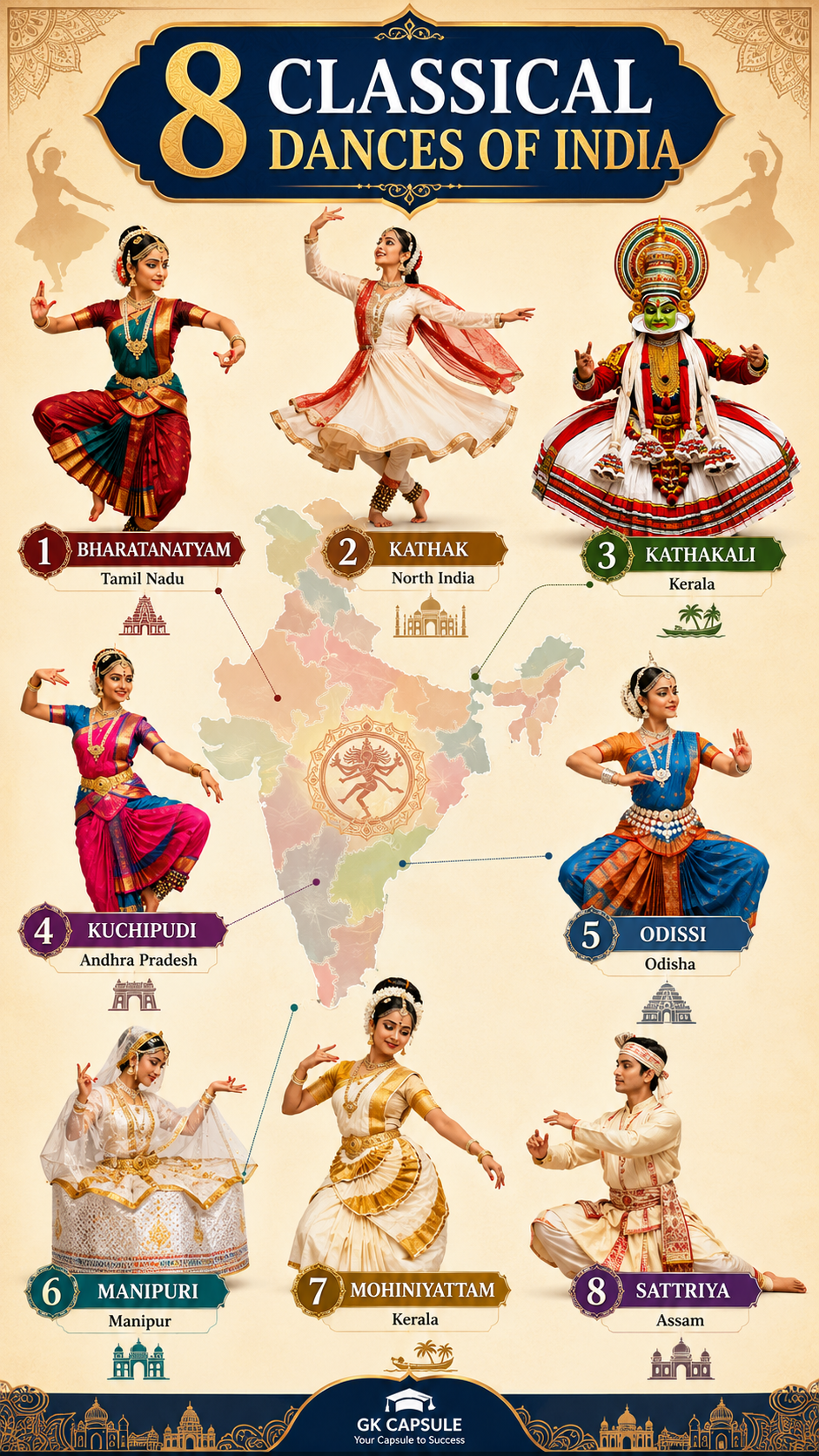
The eight classical forms recognized by the Sangeet Natak Akademi are: Bharatanatyam, Kathak, Kathakali, Kuchipudi, Odissi, Manipuri, Mohiniyattam, and Sattriya. Bharatanatyam points to Tamil Nadu, Kathak to North India, Kathakali and Mohiniyattam to Kerala, Kuchipudi to Andhra Pradesh, Odissi to Odisha, Manipuri to Manipur, and Sattriya to Assam.
Why Classical Dance Is Important for Competitive Exams
Many questions revolve around direct associations — which state is linked to a dance, which dance features Tribhanga, which tradition grew from Assam's sattras, or which form is known for elaborate facial makeup. A reliable strategy is the chain Dance → State → Signature Feature.
Natya Shastra and the Historical Roots of Classical Dance
Most classical dance traditions of India trace their theoretical foundation back to the Natya Shastra, an ancient Sanskrit treatise on dramaturgy, music, and dance attributed to the sage Bharata Muni. This text is often dated to somewhere between 200 BCE and 200 CE, and it lays out principles of rasa (aesthetic emotion), bhava (mood), gesture, stagecraft, and rhythm that continue to inform Indian performing arts today. Many exam questions on Indian classical dance actually originate from cultural-heritage sections rather than pure dance sections, and the Natya Shastra is one of the most frequently tested source texts in that broader category.
Another important textual reference is the Abhinaya Darpana, a treatise attributed to Nandikeshvara that deals specifically with hand gestures, facial expressions, and body movements used in dance. While the Natya Shastra provides the philosophical and structural foundation for performance in general, the Abhinaya Darpana is more narrowly focused on the vocabulary of expression — the mudras and glances a dancer uses to communicate meaning. Together, these two texts form the theoretical backbone referenced across nearly every classical dance tradition, even though each region eventually developed its own regional style, costume, and repertoire.
List of 8 Classical Dances of India
Their regional connections are among the most important facts for examination preparation.
| Classical Dance | State / Region | Key Feature |
|---|---|---|
| Bharatanatyam | Tamil Nadu | Temple tradition, precise movements |
| Kathak | North India, especially Uttar Pradesh | Spins, footwork and storytelling |
| Kathakali | Kerala | Elaborate makeup and dramatic expression |
| Kuchipudi | Andhra Pradesh | Dance-drama tradition |
| Odissi | Odisha | Tribhanga and graceful poses |
| Manipuri | Manipur | Devotional and graceful movements |
| Mohiniyattam | Kerala | Graceful feminine movements |
| Sattriya | Assam | Vaishnavite monastic tradition |
Kerala is associated with two forms — Kathakali and Mohiniyattam — a common exam trap. Odissi/Odisha and Manipuri/Manipur form easy name pairs, while Sattriya requires deliberate memorization via the sattras.
Bharatanatyam
Bharatanatyam is strongly associated with Tamil Nadu, developed through temple and performance traditions of South India, and is defined by precise movement, rhythm, expression, and devotional themes. The dancer combines controlled footwork with mudras, facial expression, and sculptural poses.
Features, Origin, and Famous Artists
Key features: precise footwork, mudras, facial expressions, rhythmic movements, sculptural poses, and devotional themes. Famous performers include Rukmini Devi Arundale, Balasaraswati, and Yamini Krishnamurti.
Bharatanatyam performances traditionally follow a structured sequence called the margam, which moves from pure rhythmic movement toward more expressive and devotional pieces. A typical margam includes items such as the Alarippu (an invocatory opening piece with no narrative content), the Jatiswaram (a display of pure rhythm and geometry), the Shabdam (where expressive storytelling is introduced), the Varnam (the technical and emotional centerpiece of the recital), and the concluding Tillana, a fast-paced rhythmic finale. The accompanying music is usually Carnatic, and a live ensemble typically includes a vocalist, mridangam (a double-headed drum), violin, and nattuvangam (cymbals used by the conductor to mark rhythm). Bharatanatyam has also been recognized with UNESCO-linked cultural heritage attention and remains one of the most widely taught classical forms outside India, with training academies active across Southeast Asia, Europe, and North America.
Kathak
Kathak developed in North India, particularly Uttar Pradesh. The name relates to katha (story), reflecting its narrative character, later shaped by Mughal and other court influences.
Features, Gharanas, and Cultural Influences
Recognizable through fast footwork, spins, rhythmic patterns, storytelling, expressive gestures, and ghungroo. Major gharanas include Lucknow, Jaipur, and Banaras.
Each Kathak gharana carries its own emphasis: the Lucknow Gharana is known for graceful, expressive abhinaya and courtly refinement developed under Nawab Wajid Ali Shah; the Jaipur Gharana is recognized for vigorous footwork, complex rhythmic compositions, and technical virtuosity; and the Banaras Gharana is distinguished by its use of certain hand positions and a distinctive approach to the tatkar (footwork syllables). Kathak dancers typically wear between 100 and 200 ghungroo bells tied around each ankle, and the ability to control the volume and clarity of these bells during rapid footwork sequences is considered a mark of advanced technical skill. The dance is performed to Hindustani classical music, often accompanied by tabla, sarangi, and vocal recitation of rhythmic syllables known as bols.
Kathakali
Kathakali is a dance-drama tradition of Kerala, immediately recognizable through its dramatic makeup and elaborate costumes drawing on mythological narratives.
Costumes, Makeup, and Dance-Drama Tradition
Key features: elaborate makeup, large costumes, dramatic facial expressions, hand gestures, mythological stories, and strong use of percussion.
Kathakali makeup follows a coded system known as Vesham, in which colours indicate the nature of the character being portrayed. A green face (Pacha) typically represents noble or heroic characters, a mixed red-and-green face (Kathi) represents villainous yet dignified characters, a predominantly black face often represents demons or forest-dwellers, and a bright red beard or face can indicate a particularly evil character. Performances traditionally run through the night in temple courtyards, accompanied by the chenda and maddalam drums along with vocalists who narrate the story while the performers convey it entirely through movement and expression. Stories are most often drawn from the Mahabharata, the Ramayana, and Puranic literature.
Kuchipudi
Kuchipudi originated in Andhra Pradesh, named after the village of Kuchipudi, and follows a dance-drama format with expressive storytelling, rhythmic movement, music, dialogue, and mythological themes.
Origin, Distinctive Features, and Brass Plate Tradition
A famous performance element involves the dancer performing on a brass plate — a distinctive memory hook.
Historically, Kuchipudi was performed exclusively by male Brahmin dancers as part of village dance-drama troupes, with performances often lasting an entire night and depicting stories from Hindu mythology through a combination of dance, dialogue, and song. One of its most iconic solo items is the Tarangam, in which the dancer balances on the rim of a brass plate while executing rhythmic footwork, sometimes while also balancing a pot of water on the head — a combination that demonstrates both physical control and artistic discipline. The tradition later expanded to include female performers, and today it is taught widely across Andhra Pradesh and Telangana, with structured curricula in dedicated dance institutions.
Odissi
Odissi originated in Odisha, known for distinctive body positions, graceful movement, sculptural poses, and devotional themes — most notably the Tribhanga (three-bend) posture.
Tribhanga, Chauka, and Devotional Tradition
Chauka is another important postural feature. Memorize the full chain rather than Tribhanga alone.
While Tribhanga expresses the fluid, graceful side of Odissi, Chauka represents its more grounded, square-based stance, believed to be inspired by the posture of temple deity Jagannath. This contrast between soft, flowing lines and firm, geometric stances gives Odissi a dual character rarely found in other classical forms. Odissi's revival in the twentieth century is closely associated with gurus such as Kelucharan Mohapatra, who helped restore and codify the form after a long period of decline. The dance draws heavily on sculptural imagery found in the temples of Odisha, particularly the Sun Temple at Konark and the Jagannath Temple at Puri, and its repertoire frequently depicts themes from the Gita Govinda, a devotional poem centered on Radha and Krishna.
Manipuri
Manipuri originated in Manipur and carries a strong Vaishnavite connection, particularly devotional traditions around Radha and Krishna, expressed through graceful movements, soft footwork, and Raslila traditions.
Raslila, Vaishnavism, and Distinctive Style
The name-state pairing (Manipuri–Manipur) is one of the easiest to score on.
A distinguishing feature of Manipuri dance is that its footwork is deliberately soft and largely concealed beneath long, cylindrical skirts called the Kumil, in contrast with the loud, percussive footwork emphasized in Kathak. This gives Manipuri performances a gentle, flowing visual quality even during energetic sequences. The Raslila performances, depicting the divine love of Radha and Krishna, are traditionally staged during specific festivals in the Manipuri calendar and are considered as much a devotional ritual as a performing art. Manipuri martial traditions, including the Thang-Ta form, have also influenced certain vigorous male dance sequences performed alongside the softer devotional pieces.
Mohiniyattam
Mohiniyattam belongs to Kerala and takes its name from Mohini, the enchanting female form of Vishnu. It is known for graceful, swaying movements, expressive gestures, a feminine aesthetic, and a traditional white-and-gold costume.
Meaning, Movements, Costume, and Kerala Tradition
Remember Kerala's two forms together: Kathakali + Mohiniyattam, contrasted by dramatic makeup versus graceful swaying.
Unlike Kathakali's dramatic, masculine-coded energy, Mohiniyattam is traditionally performed solo by women and is built around the Lasya style — gentle, lyrical, and romantic movement, as opposed to the vigorous Tandava style associated with more dramatic forms. The dancer's body sways gently from side to side, with circular movements of the torso and delicate footwork that avoid sharp angles. Mohiniyattam nearly disappeared during the colonial period but was revived in the twentieth century largely due to the efforts of poet Vallathol Narayana Menon, who established the Kerala Kalamandalam to preserve Kerala's classical art forms. The musical accompaniment is typically in the Carnatic tradition, sung in Malayalam, distinguishing it from the Sanskrit or Telugu-influenced repertoires of some other forms.
Sattriya
Sattriya originated in Assam, developing within the Vaishnavite monastic tradition of the sattras, closely associated with Srimanta Sankardeva.
Srimanta Sankardeva and the Sattras
Unlike other forms, the name doesn't hint at the state — build the Assam connection deliberately.
Sattriya originated in the fifteenth-sixteenth century as part of a devotional and social reform movement led by the saint-scholar Srimanta Sankardeva, who established monastic institutions called sattras to spread Vaishnavite teachings through art, drama, and music. For centuries the dance was performed exclusively by monks (bhokots) within these monasteries as a form of worship rather than public entertainment, which is part of why it remained less internationally known than forms like Bharatanatyam or Kathak for much longer. It was formally recognized as a classical dance form by the Sangeet Natak Akademi only in the year 2000 — the most recent of the eight to receive that recognition. Traditional accompaniment includes the khol (a barrel drum), taal (cymbals), and Borgeet devotional songs composed by Sankardeva himself.
Classical Dance vs Folk Dance
Classical traditions rest on established artistic techniques, structured repertoires, and formalized systems of expression, while folk dances are tied to communities, local customs, festivals, and occupations.
| Classical Dance | Folk Dance |
|---|---|
| Developed through established artistic traditions | Closely connected with community traditions |
| Formalized techniques | Often more community-oriented |
| Structured repertoire | Often linked with festivals and local customs |
| Includes recognized classical forms | Includes hundreds of regional forms |
Examples of folk dances: Bhangra, Garba, Ghoomar, Bihu, Lavani, and Dandiya — do not confuse these with the eight classical forms.
Important Terms in Indian Classical Dance
Four terms appear frequently: Mudra (a symbolic hand gesture), Abhinaya (expressive communication of meaning and emotion), Nritta (pure rhythmic movement without narrative meaning), Nritya (expressive movement combined with meaning), and Natya (dramatic representation and storytelling).
Classical Dances of India: State-Wise Revision
| State / Region | Classical Dance |
|---|---|
| Tamil Nadu | Bharatanatyam |
| Uttar Pradesh / North India | Kathak |
| Kerala | Kathakali, Mohiniyattam |
| Andhra Pradesh | Kuchipudi |
| Odisha | Odissi |
| Manipur | Manipuri |
| Assam | Sattriya |
The most important trap is Kerala's two entries. Odissi belongs to Odisha, Sattriya belongs to Assam — keep these distinct.
Recognition, Awards, and Institutions
The Sangeet Natak Akademi, India's national academy for music, dance, and drama, is the body responsible for officially recognizing classical dance forms and administers the highest performing-arts honour in the country — the Sangeet Natak Akademi Award (also called the Akademi Ratna/Akademi Puraskar). Many senior classical dancers additionally receive civilian honours such as the Padma Shri, Padma Bhushan, or Padma Vibhushan for lifetime contributions to their art form; competitive exams occasionally test which award a particular artist received, so cross-referencing famous names with these honours can be a useful advanced-revision step.
Dedicated institutions have played a major role in sustaining several of these traditions. Kalakshetra in Chennai, founded by Rukmini Devi Arundale, remains one of the most prominent centres for Bharatanatyam training. Kerala Kalamandalam, founded by Vallathol Narayana Menon, has similarly served as the primary training ground for Kathakali and Mohiniyattam. These institutional names occasionally appear in exam questions that connect a person, a place, and a dance form together.
Common Mistakes to Avoid
A few recurring errors show up across practice tests and can cost otherwise well-prepared candidates easy marks:
- Confusing Kerala's two dances: assuming only one classical form exists for Kerala. Both Kathakali and Mohiniyattam belong there.
- Mixing up Odissi and Sattriya: both are devotional and Vaishnavite-influenced in parts of their history, but Odissi belongs to Odisha while Sattriya belongs to Assam.
- Treating folk dances as classical: Bhangra, Garba, Bihu (the folk dance, as distinct from Sattriya's Assamese origin), and Dandiya are folk traditions, not part of the eight recognized classical forms.
- Forgetting Sattriya altogether: because it was recognized more recently than the other seven, some revision material omits it, leading candidates to default to only seven forms.
- Reversing Tribhanga and Chauka: Tribhanga is the flowing three-bend posture; Chauka is the grounded, square stance. Questions sometimes swap these to test attentiveness.
Classical Dances of India MCQs
Q1. Which classical dance is associated with Tamil Nadu?
- Kathak
- Bharatanatyam
- Sattriya
- Manipuri
Q2. Kathak is primarily associated with which region?
- Northeast India
- North India
- South India
- Eastern India
Q3. Which classical dance is associated with Kerala and is known for elaborate makeup and dramatic presentation?
- Odissi
- Kuchipudi
- Kathakali
- Sattriya
Q4. Sattriya is associated with which state?
- Assam
- Manipur
- Odisha
- Bihar
Q5. Which classical dance is particularly famous for the Tribhanga posture?
- Kathak
- Odissi
- Bharatanatyam
- Sattriya
Q6. Kuchipudi originated in which state?
- Karnataka
- Kerala
- Andhra Pradesh
- Tamil Nadu
Q7. Which classical dance is associated with Manipur?
- Manipuri
- Mohiniyattam
- Kathakali
- Odissi
Q8. Mohiniyattam belongs to which state?
- Kerala
- Assam
- Odisha
- Gujarat
Q9. Which dance tradition is strongly associated with Vaishnavite monastic institutions called sattras?
- Kathak
- Sattriya
- Bharatanatyam
- Kathakali
Q10. Which two classical dance traditions are associated with Kerala?
- Kathak and Odissi
- Kuchipudi and Kathakali
- Kathakali and Mohiniyattam
- Manipuri and Sattriya
How to Prepare Classical Dance for Competitive Exams
Break the topic into three layers: dance, state, feature. First memorize the eight dance-state associations, then add one distinctive feature to each, and finally layer in special terms, performers, and cultural connections.
Practice questions without checking answers immediately, and pay special attention to Kerala's two forms. High-value keywords for final revision: Tamil Nadu, North India, Kerala, Andhra Pradesh, Odisha, Manipur, Assam, Tribhanga, Raslila, sattras, Mohini, mudra, Abhinaya, Nritta, Nritya, Natya.
Frequently Asked Questions
How many classical dances are there in India?
Eight classical dance forms are generally recognized by the Sangeet Natak Akademi: Bharatanatyam, Kathak, Kathakali, Kuchipudi, Odissi, Manipuri, Mohiniyattam, and Sattriya.
Which is the classical dance of Tamil Nadu?
Bharatanatyam is associated with Tamil Nadu, known for precise footwork, mudras, facial expressions, rhythmic movement, sculptural poses, and devotional themes.
Which classical dances belong to Kerala?
Kathakali and Mohiniyattam. Kathakali is known for elaborate makeup and dramatic expression, while Mohiniyattam emphasizes graceful, swaying movement.
Which classical dance belongs to Assam?
Sattriya, which developed within the Vaishnavite monastic tradition of the sattras and is closely connected with Srimanta Sankardeva.
Which classical dance is famous for Tribhanga?
Odissi, particularly known for the Tribhanga posture — a characteristic three-bend posture of the body. Odissi originated in Odisha.
Which classical dance originated in Andhra Pradesh?
Kuchipudi, traditionally associated with a dance-drama format and dancing on a brass plate as a notable performance element.
Which classical dance is associated with Manipur?
Manipuri, with strong Vaishnavite connections linked to devotional traditions involving Radha and Krishna and Raslila.
Which classical dance is associated with storytelling, fast footwork, and spins?
Kathak, known for storytelling, intricate footwork, rhythmic patterns, spins, expressive gestures, and the use of ghungroo.
Conclusion
The classical dances of India are easiest to master as a cultural map rather than eight unrelated names: Bharatanatyam with Tamil Nadu, Kathak with North India, Kathakali and Mohiniyattam with Kerala, Kuchipudi with Andhra Pradesh, Odissi with Odisha, Manipuri with Manipur, and Sattriya with Assam. Keep revising the state-wise table, test yourself with MCQs, and use distinctive keywords as memory anchors.